What's Really Causing Your Adult Acne (Hint: It Starts in Your Gut)
If your skin is still breaking out in your 20s, 30s or 40s, the cause is rarely on the surface. The emerging science of the gut-skin axis is changing how we understand — and treat — persistent adult acne.


Adult acne carries a particular kind of frustration. You are doing everything right: cleansing properly, using SPF, spending real money on skincare. And yet your chin is congested, your jawline flares every three weeks like a clock, and no amount of salicylic acid seems to change the underlying pattern.
The reason topical-only approaches often fail for adult acne is that they are treating the symptom — the spot — without addressing what is actually driving it. For the majority of adult women with persistent breakouts, the primary causes are internal: hormonal imbalance, a disrupted gut microbiome, and the way these two systems interact.
Here is what the research actually says.
Acne in Adults Is Not the Same as Teenage Acne
Adolescent acne is largely driven by the dramatic hormonal surge of puberty — elevated androgens across the board, for everyone going through it. It tends to appear on the forehead and nose, often resolves in the mid-20s, and responds well to standard topical treatments.
Adult acne — defined as acne persisting beyond 25, or new-onset acne after 25 — has different characteristics. It tends to cluster on the lower face: chin, jaw, neck. It is more often inflammatory (painful, deep cysts rather than surface pustules). It follows cyclical patterns tied to the menstrual cycle. And it is significantly more common in women than men — the reverse of adolescent acne.
These differences point to different underlying drivers. For adult acne, the hormonal and gut factors are far more dominant than they are in teenage skin.
Driver 1: Hormonal Imbalance
Androgens — testosterone and dihydrotestosterone (DHT) — are the primary hormonal driver of acne. They stimulate sebaceous glands to produce more sebum (skin oil), which, combined with dead skin cells and C. acnes bacteria, creates the conditions for blocked pores and inflammation.
In adult women, the situations that most commonly produce androgen-related acne are:
The luteal phase of the menstrual cycle. In the two weeks before menstruation, progesterone rises and oestrogen falls. Progesterone promotes sebum production, and the relative drop in oestrogen reduces its anti-inflammatory, anti-sebum effect. This is why many women reliably break out in the week or so before their period.
Perimenopause. During the transition to menopause, oestrogen levels decline and fluctuate. Since oestrogen normally counterbalances androgens, its decline leaves androgens relatively more dominant — increasing sebum production and sensitivity of the sebaceous glands. Women in their late 30s and 40s who have never had significant acne often encounter it for the first time during perimenopause.
PCOS (polycystic ovary syndrome). Elevated androgens are a defining feature of PCOS and a leading cause of persistent adult acne. If your acne is accompanied by irregular periods, excess hair growth, or difficulty managing weight, PCOS is worth investigating with your GP.
Post-hormonal contraceptive acne. Some women experience significant breakouts after stopping hormonal contraception, as the suppressive effect on androgens is removed.
Driver 2: The Gut Microbiome
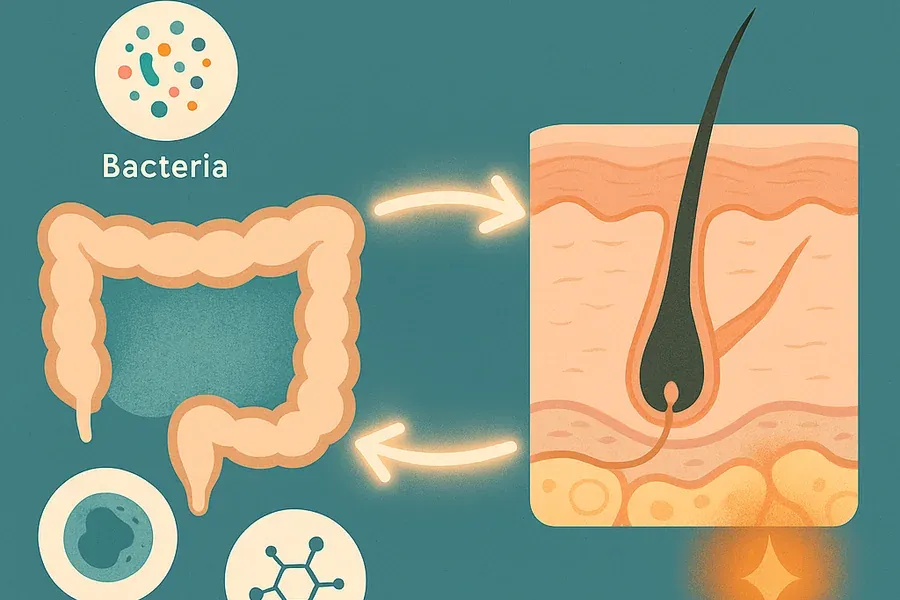
The connection between gut health and skin health has moved from fringe theory to mainstream research interest in recent years. The evidence is accumulating:
- Studies comparing the gut microbiomes of people with and without acne consistently find lower bacterial diversity in the acne group, with reduced populations of anti-inflammatory species like Lactobacillus and Bifidobacterium
- People with acne show higher rates of intestinal permeability (often called "leaky gut"), which allows inflammatory compounds to enter the bloodstream and promote systemic inflammation
- The gut microbiome is responsible for metabolising and clearing oestrogen; disrupted gut flora can cause oestrogen to be reabsorbed rather than excreted, contributing to hormonal imbalance
- Conditions associated with gut dysbiosis — IBS, inflammatory bowel conditions, SIBO — are significantly more prevalent in people with acne and rosacea than in the general population
This does not mean your gut is the sole cause of your acne. But for many adults with persistent breakouts, especially those with digestive symptoms, addressing gut health is often the piece that makes everything else work.
→ Deep dive: The Complete Guide to Hormonal Acne and the Gut-Skin Axis
Driver 3: Diet and Blood Sugar
The diet-acne link was dismissed for decades but is now robustly supported. The most evidence-consistent dietary drivers of acne are:
High-glycaemic foods. Foods that rapidly raise blood sugar — white bread, white rice, sugary drinks, processed snacks — trigger insulin spikes. Insulin promotes the release of IGF-1 (insulin-like growth factor 1), which in turn stimulates androgen production and sebum output. High-GI diets have been shown in randomised trials to worsen acne.
Dairy, particularly skimmed milk. The association between milk consumption and acne is one of the most replicated findings in dermatological nutrition research. Milk contains hormonal precursors (including androgens and IGF-1), and skimmed milk has been more consistently linked to acne than full-fat — possibly because the fat in whole milk modulates the hormonal components.
Ultra-processed food. Beyond their glycaemic impact, ultra-processed foods tend to be low in fibre, which feeds the gut bacteria that support healthy oestrogen metabolism and reduce systemic inflammation.
Driver 4: Nutrient Deficiencies
Several nutrient deficiencies are significantly more prevalent in people with acne than in those with clear skin:
Zinc — involved in sebum regulation, immune function, and inhibition of C. acnes. Zinc deficiency is common and often overlooked.
Vitamin D — a key regulator of immune activity and skin barrier function. Low vitamin D levels are associated with increased acne severity, and deficiency is widespread in northern climates.
Omega-3 fatty acids — reduce the inflammatory signalling that drives acne lesion formation. The typical Western diet is heavy in omega-6 (pro-inflammatory) and low in omega-3.
Vitamin A — essential for normal skin cell turnover. Severe deficiency causes follicular hyperkeratosis (the same mechanism that drives comedonal acne). This is why retinoids — topical forms of vitamin A — are so effective for acne.
Driver 5: Stress and Sleep
Cortisol, the primary stress hormone, directly stimulates androgen production and sebum output. It also increases intestinal permeability, disrupts the gut microbiome, and elevates inflammatory markers. The gut-brain-skin axis means that psychological stress translates into physiological changes that land on your face.
Sleep deprivation compounds this: poor sleep elevates cortisol, disrupts the microbiome, and reduces the overnight skin repair processes that normally clear minor congestion before it becomes a spot.
Is It Really My Gut? Signs to Look For
Your gut may be a primary factor in your acne if you experience:
- Digestive symptoms (bloating, irregular bowel movements, discomfort after eating) alongside breakouts
- Skin that flares after courses of antibiotics (which disrupt the gut microbiome)
- A pattern of breakouts after eating certain foods, particularly high-sugar or high-dairy meals
- Other inflammatory or immune-related conditions such as food sensitivities, frequent infections, or fatigue
- Acne that doesn't respond to topical treatment but does seem to correlate with what you eat
What This Means for Treatment
Understanding the underlying driver changes the approach. If your acne is primarily hormonal, hormonal management — via contraception, spironolactone, or lifestyle approaches that reduce androgen load — is often the most direct route. If the gut is a primary factor, microbiome support, dietary adjustment, and targeted supplementation can produce dramatic improvements that no topical treatment alone would achieve.
In practice, most adult acne is multifactorial. A layered approach — addressing diet, gut health, nutrient status, stress, and using appropriate topical actives — consistently outperforms any single intervention.
→ How to Clear Hormonal Acne from the Inside Out
→ My Hormonal Acne Cleared Up When I Fixed My Gut — Here's What I Did
→ Skin Purging vs Breaking Out: How to Tell the Difference
→ The Complete Guide to the Gut-Skin Axis