Cortisol & Men's Health: What You Need to Know
Cortisol in men drives belly fat, low testosterone, poor sleep, and brain fog. Learn what disrupts it and 6 evidence-based ways to fix it.


You've probably written cortisol off as a "stress hormone" that only matters to burned-out executives or wellness influencers. But cortisol in men is directly tied to belly fat, testosterone, sleep quality, mental focus, and sustained energy — and it's one of the most overlooked levers in male health, especially after 40.
Wired but exhausted? Gaining weight despite consistent workouts? Waking up at 3 a.m. for no obvious reason? These aren't random annoyances. They're classic signs that your cortisol rhythm is off — and your body is trying to tell you something.
Here's what cortisol actually does, why it matters so much for men, and what you can do right now to get it back under control.

What Cortisol Actually Does in the Body
Cortisol is produced by the adrenal glands, two small glands that sit on top of your kidneys. Its job is to help your body respond to stress, regulate blood sugar, control inflammation, and maintain energy throughout the day (Peters et al., 2019).
Under normal conditions, cortisol follows a predictable daily rhythm: high in the morning to get you alert and moving, then declining gradually through the evening so you can wind down and sleep. That rhythm is called the cortisol awakening response, and when it works properly, you feel naturally energized in the morning and naturally tired at night.
The problem? That rhythm is fragile. Poor sleep, chronic overwork, blood sugar swings, emotional pressure, and overtraining can all knock it out of alignment — often without you even realizing it.
Why Cortisol in Men Is a Bigger Deal Than Most Realize
Chronically elevated or dysregulated cortisol doesn't just make you feel stressed — it silently reshapes your physiology in ways that compound over time. When cortisol is persistently high or swinging unpredictably, the downstream effects include:
- Belly fat accumulation — cortisol promotes fat storage, particularly around the abdomen
- Suppressed testosterone — the body deprioritizes sex hormone production when it's in survival mode
- Disrupted sleep — elevated evening cortisol makes it hard to fall asleep and stay asleep
- Brain fog and low motivation — cortisol interferes with dopamine and prefrontal cortex function
- Elevated blood pressure — a direct consequence of prolonged HPA axis activation
- Burnout — adrenal fatigue and cortisol dysregulation are closely linked
Men over 40 are especially vulnerable because testosterone is already declining with age, sleep architecture is shifting, and recovery takes longer. Adding cortisol dysfunction on top of that creates a compounding effect that standard advice — eat less, exercise more — simply doesn't fix.
5 Things That Wreck Male Cortisol Rhythms
1. Chronic Pressure to Perform
Men are often culturally conditioned to push through fatigue and suppress vulnerability. That ongoing internal pressure keeps the nervous system in a low-grade fight-or-flight state. Over time, this leads to HPA axis dysfunction — where cortisol becomes dysregulated even after the original stressor is long gone (Russell & Lightman, 2019).
2. Sleeping Less Than 6 Hours
Sleep is when your cortisol rhythm resets. Research shows that sleeping fewer than 6 hours per night correlates with disrupted cortisol patterns, reduced insulin sensitivity, lower testosterone, and increased visceral fat in men over 40 (Wang et al., 2019). Cutting sleep to get more done is a direct trade-off against hormonal health.
3. Blood Sugar Swings From Poor Nutrition
A diet high in refined carbs, sugar, or irregular meal timing forces cortisol to act as a blood sugar stabilizer. Every time glucose drops sharply, cortisol surges to compensate. Done repeatedly, this taxes the adrenals and keeps stress hormones elevated throughout the day (Papakonstantinou et al., 2019).
4. Overtraining Without Recovery
Exercise is one of the best cortisol regulators — until it isn't. Too much high-intensity training without adequate rest, sleep, and nutrition flips the equation. Chronically elevated exercise-induced cortisol suppresses testosterone and delays recovery (Hough et al., 2020). More isn't always better.
5. Internalized Emotional Stress
Research confirms that men tend to under-report emotional distress — but internalized stress produces just as strong a cortisol response as stress that's openly expressed (Taylor et al., 2020). Your adrenal glands don't distinguish between physical threats, work pressure, or unspoken anxiety. They respond to all of it.
How to Tell If Your Cortisol Is Off
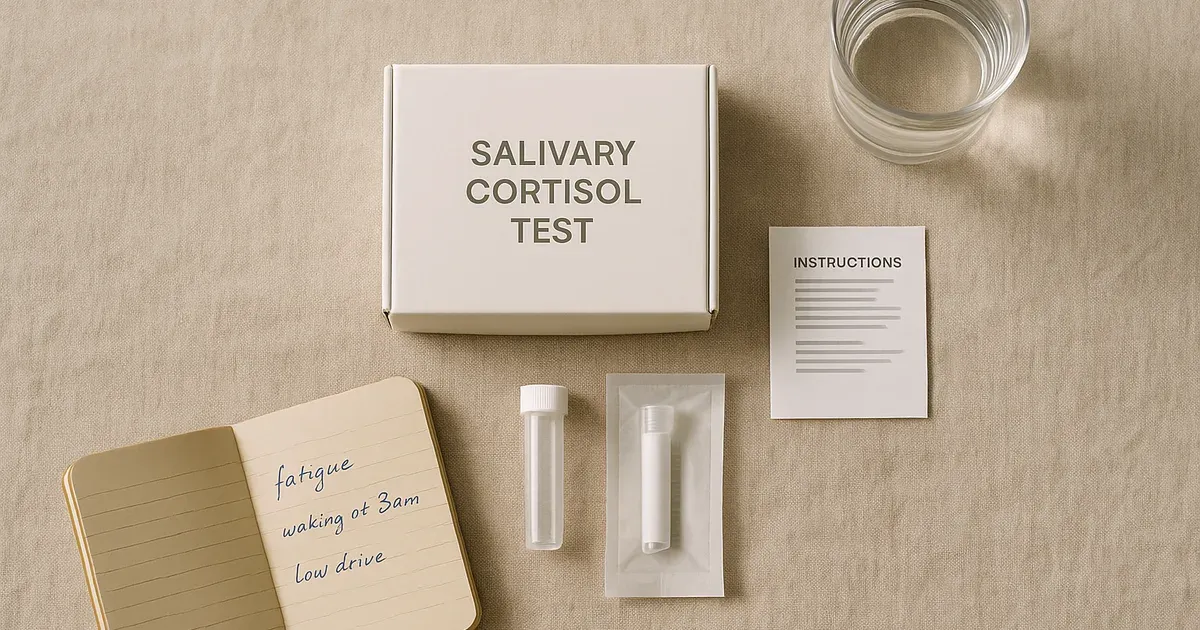
You don't have to guess. Functional lab testing — specifically a 4-point salivary cortisol test or a DUTCH hormone panel — can map your cortisol levels at different points throughout the day and reveal patterns a standard blood draw will miss.
But while you're deciding whether to test, watch for these red flags:
- Afternoon energy crashes that hit like a wall, usually between 2–4 p.m.
- Feeling wired at night but sluggish and unrested in the morning
- Stubborn belly fat that doesn't respond to diet or exercise
- Cognitive fog — difficulty concentrating, poor memory, slow thinking
- Heavy reliance on caffeine just to reach baseline function
- Waking between 2–4 a.m. regularly, often with a racing mind
If three or more of these sound familiar, cortisol dysregulation is a reasonable hypothesis worth investigating — not ignoring.
6 Evidence-Based Ways to Rebalance Cortisol in Men
Rebalancing cortisol doesn't require radical lifestyle overhauls. It requires consistent, targeted habits that address the underlying drivers. Here's what the evidence supports:
1. Protect Sleep Above Almost Everything Else
Aim for 7–9 hours in a cool, dark room. Shut down screens 30–60 minutes before bed and build a short wind-down routine — even 15 minutes of low stimulation signals the nervous system that the day is over. Sleep is the single most powerful cortisol reset available.
2. Build Meals Around Protein, Fat, and Fiber
Stable blood sugar means less cortisol demand throughout the day. Structure meals around quality protein, healthy fats, and fiber-rich carbohydrates. Avoid skipping meals or eating high-carb meals alone. Consistent fuel reduces the hormonal burden on your adrenals (Papakonstantinou et al., 2019).

3. Match Exercise Intensity to Your Recovery Capacity
If you're already running on cortisol fumes, more HIIT is not the answer. Strength training, Zone 2 cardio, walking, and yoga all support healthy cortisol regulation without overstimulating the stress response (Hough et al., 2020). Exercise should leave you feeling better than before — not depleted.
4. Build a Daily Stress Outlet
You don't need to meditate for an hour. Ten minutes of intentional breathwork, morning sunlight exposure, cold water immersion, or even journaling can meaningfully calm the nervous system and help recalibrate your cortisol response over time (Pascoe et al., 2019). Consistency matters more than intensity here.
5. Support Your Adrenals With the Right Nutrients
Key nutrients involved in cortisol regulation include magnesium, vitamin C, and vitamin B5. Herbal adaptogens — particularly ashwagandha and rhodiola — have research-backed support for modulating cortisol responses and supporting adrenal resilience (Panossian et al., 2019). Supporting mitochondrial function and reducing oxidative stress through the Nrf2 pathway can also improve your body's overall stress response capacity.
Always consult a qualified provider before starting supplements, especially if you take medications.
6. Test, Don't Guess
Ask your provider for a comprehensive hormone panel that includes a 4-point salivary or DUTCH cortisol test, DHEA-S, total and free testosterone, and inflammatory markers like hsCRP. These data points together reveal patterns that explain symptoms no basic blood panel will uncover. Functional testing turns vague complaints into an actionable plan.

The Bottom Line on Cortisol and Men's Health
Cortisol in men is not a niche wellness topic — it's a central hormonal driver of energy, body composition, testosterone, sleep, and cognitive performance. And in an era of constant digital stimulation, performance pressure, and sleep deprivation, dysregulated cortisol is far more common than most men realize.
The good news is that it's addressable. Sleep, nutrition, smart training, daily stress outlets, and targeted supplementation can meaningfully shift your cortisol rhythm over weeks — not months. The prerequisite is knowing your actual numbers, not just guessing based on symptoms.
If you've been pushing through fatigue and wondering why your usual strategies stopped working, cortisol may be the missing variable. Get the data. Then act on it.
References
Peters A, McEwen BS, Friston K. Uncertainty and stress: Why it causes diseases and how it is mastered by the brain. Prog Neurobiol. 2019;156:164–188.
Russell GM, Lightman SL. The human stress response and its impact on health. Lancet Diabetes Endocrinol. 2019;7(8):628–636.
Wang W, et al. Sleep duration and risk of metabolic syndrome. Sleep Health. 2019;5(6):632–640.
Papakonstantinou E, et al. High glycemic index carbohydrate consumption increases cortisol and ACTH. Nutrients. 2019;11(9):2093.
Hough J, et al. Cortisol responses to high-intensity interval training. Sports Med Open. 2020;6(1):1–13.
Taylor MK, et al. Gender differences in stress reactivity and coping styles. Front Psychol. 2020;11:712.
Panossian A, et al. Adaptogens in mental and behavioral disorders. Curr Neuropharmacol. 2019;17(3):181–193.
Pascoe MC, et al. Mindfulness mediates the physiological markers of stress. J Psychiatr Res. 2019;110:115–127.