Cycle Syncing Workouts: A Complete Guide
Learn how cycle syncing workouts align your training with your menstrual cycle phases to boost energy, improve recovery and build lasting consistency.


Have you ever had a week where you felt unstoppable in the gym — then the very next week, even a warm-up felt like climbing a mountain? That frustrating inconsistency is not a motivation problem. It is biology.
Your menstrual cycle drives significant hormonal shifts throughout the month, and those shifts directly affect your energy, strength, recovery and mood. Cycle syncing workouts is the practice of aligning your training to those natural hormonal rhythms — so you stop fighting your body and start working with it.
This guide breaks down exactly how to do that, phase by phase, with a practical plan you can start this week.

What Are Cycle Syncing Workouts and Why Do They Work?
Cycle syncing is the method of structuring your fitness routine around the four phases of your menstrual cycle: menstrual, follicular, ovulatory and luteal. Each phase is governed by different hormones — primarily estrogen and progesterone — that rise and fall in predictable patterns.
Those hormonal changes are not abstract. They shape how much energy you have, how well your muscles recover, how motivated you feel and even how your cardiovascular system performs. Ignoring them and following a rigid, one-size-fits-all training plan is like driving with the handbrake on half the month.
The science supports this approach. Research shows that estrogen, which peaks in the follicular and ovulatory phases, can enhance strength and endurance performance. Progesterone, which rises in the luteal phase, raises your resting core temperature and can increase perceived exertion during intense exercise. Understanding these shifts lets you train smarter, not just harder.
Cycle syncing workouts are not about doing less. They are about doing the right work at the right time — maximising output when your body is primed for it and prioritising recovery when it needs it most.
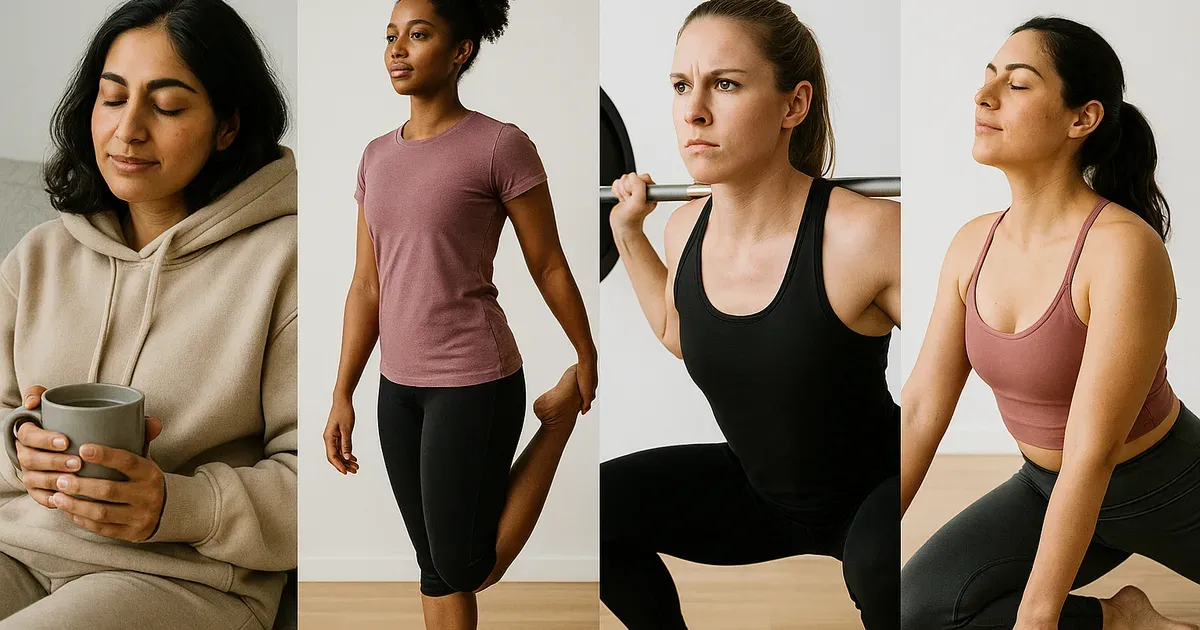
The Real Benefits of Syncing Your Training to Your Cycle
Most women are never taught that their physiology changes week to week. The result is a cycle of overtraining, burnout, guilt over missed sessions and confusion about why performance fluctuates so wildly. Cycle syncing addresses all of that.
Here is what you can expect when you align your cycle syncing workouts with your hormonal phases:
- Better workout efficiency — You push harder during high-energy phases and recover smarter during low-energy ones, reducing wasted effort.
- Fewer missed workouts — A flexible structure that accounts for lower-energy days means you are less likely to skip, because rest is built in intentionally.
- Improved recovery — Scheduling lighter work during the luteal and menstrual phases gives your body the restoration time it needs.
- Steadier mood and energy — Working with hormonal fluctuations rather than against them reduces the stress spikes that come from forcing intensity on the wrong days.
- Stronger mind-body connection — Paying attention to how you feel at each phase builds long-term self-awareness and consistency.
Even implementing just one or two of these adjustments per week can produce noticeable changes within a single cycle.
How to Sync Your Workouts With Each Phase of Your Cycle
Understanding each phase is the foundation of cycle syncing workouts. Here is a clear breakdown of what is happening hormonally, how that affects your body and what training style fits best.
Menstrual Phase (Days 1–5)
This is when your period begins. Estrogen and progesterone are at their lowest, which is why energy dips and some women experience cramping, fatigue or low mood.
What to do: Prioritise rest and gentle movement. Walking, restorative yoga, light stretching and breathwork are ideal. This is not the time to chase PRs or push through a high-intensity session. Listen to your body — if it says rest, rest is the workout.
What to skip: High-intensity interval training, heavy lifting and anything that spikes cortisol significantly. Adding physical stress on top of the physiological demands of menstruation can deepen fatigue and slow recovery.
Follicular Phase (Days 6–13)
After your period ends, estrogen begins to rise and with it, energy, motivation and mood improve steadily. This is one of the most productive training windows of the month.
What to do: Reintroduce strength training, moderate cardio and new workout styles. Your body adapts well to new stimuli during this phase, making it an excellent time to try a new class, increase weights or push your cardio endurance. Two to three strength sessions and one to two cardio workouts per week work well here.
Why it works: Rising estrogen supports muscle protein synthesis and reduces inflammation, meaning you recover faster and build more efficiently during this window.

Ovulatory Phase (Days 14–16)
Estrogen peaks around ovulation, and testosterone also rises briefly. This short window is your body's performance peak — strength, speed, coordination and pain tolerance are all at their highest.
What to do: Schedule your most demanding workouts here. High-intensity interval training, personal record attempts, team sports, circuit training — this is the time. Keep sessions focused and powerful rather than long and drawn out, to avoid tipping into overtraining.
One caveat: Research suggests that ligament laxity increases slightly during ovulation due to hormonal shifts, so warm up thoroughly and pay attention to joint stability during explosive movements.
Luteal Phase (Days 17–28)
After ovulation, progesterone rises while estrogen gradually declines. Energy drops in waves, body temperature rises slightly and many women experience PMS symptoms in the final days of this phase.
What to do: Transition to strength-based work at moderate intensity, Pilates, yoga, core training and mobility sessions. Balance work is particularly effective here. The goal is to maintain progress without taxing your system unnecessarily.
What to watch: Cravings, bloating and mood shifts are common in the late luteal phase. Fuelling well with complex carbohydrates and staying hydrated can help manage these symptoms and support your training quality.

A Practical Cycle Syncing Workout Plan
You do not need an app or a complicated system to start cycle syncing workouts. The following framework gives you a clear structure for each phase that is flexible enough to adapt to your life.
Menstrual Phase (Days 1–5)
- Daily: gentle walk (20–30 minutes) or restorative yoga
- Avoid: HIIT, heavy lifting, intense cardio
- Focus: breathwork, sleep quality, hydration
Follicular Phase (Days 6–13)
- 2–3 strength training sessions (progressive overload, compound lifts)
- 1–2 moderate cardio sessions (cycling, swimming, running)
- Optional: try one new class or movement style
Ovulatory Phase (Days 14–16)
- 2 high-intensity workouts (HIIT, sprints, circuit training)
- 1 group fitness or team-based session for added motivation
- Keep sessions to 30–45 minutes — quality over quantity
Luteal Phase (Days 17–28)
- 2 strength or core-focused sessions at moderate intensity
- 1 recovery-focused workout (yoga, Pilates, foam rolling)
- Daily: light walks and mobility work as needed
This plan is a template, not a rigid prescription. Some months your energy will not follow the textbook pattern, and that is completely normal. The goal is awareness and adaptability, not perfection.
How to Get Started With Cycle Syncing
Starting is simpler than it sounds. You do not need to overhaul your entire training programme overnight. Here are practical steps to ease in:
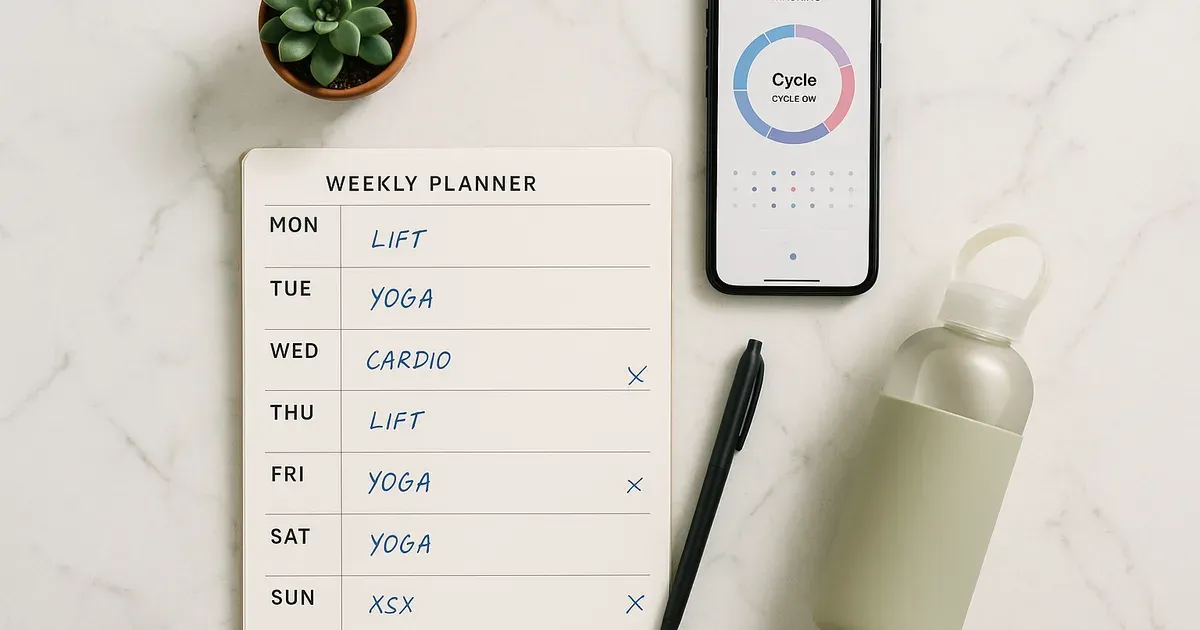
- Track your cycle. Use a dedicated app, a simple calendar or a journal. Knowing where you are in your cycle is the non-negotiable foundation. Even one month of tracking gives you enough data to start making adjustments.
- Start with one change. Rather than restructuring your whole week, begin by adjusting a single workout. On day one of your period, swap your usual HIIT for a walk. Notice how you feel. Build from there.
- Log your energy and performance. Keep brief notes alongside your cycle tracking — how strong you felt, how well you slept, how quickly you recovered. Patterns emerge fast and give you personalised data no generic plan can offer.
- Be flexible with your expectations. No two cycles are identical. Stress, travel, illness and life events all influence your hormones. Cycle syncing is a framework, not a formula. When in doubt, let how you feel guide you more than what day of the month it is.
- Consider working with a trainer. A certified personal trainer who understands hormonal health can help you build a programme tailored specifically to your physiology, goals and lifestyle — especially if you have conditions like PCOS, endometriosis or perimenopause that affect your cycle.
Common Questions About Cycle Syncing Workouts
Is cycle syncing only for people with regular cycles? No. While it is easier to implement with a predictable cycle, the principles still apply if your cycle is irregular. Focus on tracking symptoms and energy levels rather than exact day numbers. Over time, patterns will emerge even in irregular cycles.
What if I am on hormonal contraception? Hormonal birth control alters the natural hormonal fluctuations that cycle syncing is based on. The phases may not apply in the same way. However, many people on contraception still notice energy and mood shifts throughout the month and can benefit from a modified approach. Consult with a healthcare provider for personalised guidance.
How long before I notice a difference? Most people notice meaningful changes — better energy, reduced guilt around rest days, more consistent performance — within one to two cycles. The longer you track and adjust, the more refined your approach becomes.
Can I still hit my strength goals if I ease off during some phases? Absolutely. Strategic recovery is a core component of any effective strength programme. Reducing intensity during the menstrual and late luteal phases does not erase progress — it protects it by preventing the chronic fatigue and overtraining that stall long-term gains.
The Bottom Line on Cycle Syncing Workouts
Your body is not the same every week, and your training plan should not be either. Cycle syncing workouts offer a science-informed, intuitive framework for training in a way that respects your hormonal reality rather than ignoring it.
The four phases of your cycle — menstrual, follicular, ovulatory and luteal — each create distinct physiological conditions. Matching your training intensity to those conditions means you extract more value from your high-energy days, protect your body during lower-energy ones and build a fitness routine you can sustain for the long term.
Start small. Track your cycle. Adjust one workout at a time. Your body has been giving you signals all along — cycle syncing is simply the practice of finally listening to them.