7 Hidden Factors Spiking Your Cortisol at Menopause
7 research-backed factors driving cortisol during the menopausal transition — from FSH and estrogen to adrenaline and hot flashes.


You wake at 3 a.m. drenched in sweat, your heart racing, your mind looping through tomorrow's to-do list. You blame stress or poor sleep — but the real driver may be a silent hormonal chain reaction happening deep inside your body. Cortisol levels rise in measurable, predictable ways during the menopausal transition, and most women — and their doctors — never connect the dots. Understanding exactly what is pushing that cortisol higher could change how you approach this stage of life entirely.
A 15-year longitudinal study — the Seattle Midlife Women's Health Study — tracked 132 women across up to 5,218 overnight urine observations and found that biological hormonal markers, not lifestyle stress, were the strongest predictors of rising overnight cortisol during the menopausal transition.

1. Falling Estrogen Sends Your Stress Hormone Soaring
Estrone glucuronide (E1G), a urinary marker of estrogen activity, was one of the single strongest predictors of overnight cortisol in the Seattle study — and its relationship was statistically significant at p<.0001. As ovarian estrogen production becomes erratic during the transition, the hypothalamic-pituitary-adrenal (HPA) axis compensates, amplifying cortisol output. The HPA and hypothalamic-pituitary-ovarian (HPO) axes are deeply integrated, meaning a disruption in one reliably echoes in the other. Actionable takeaway: Track your cycle irregularity as an early signal that your HPA axis may already be shifting — not just your reproductive system.
2. Rising FSH Doesn't Just Signal Menopause — It Drives Cortisol Up
Follicle-stimulating hormone (FSH) rises steeply as the ovaries become less responsive during the late menopausal transition, and the Seattle study confirmed it was independently associated with higher overnight cortisol levels. FSH is not a passive bystander — it reflects a pituitary system working harder to recruit ovarian follicles, and that systemic effort appears to activate adrenal stress pathways simultaneously. Think of FSH as both a messenger and a stressor in its own right. Actionable takeaway: Ask your clinician for FSH alongside cortisol testing during perimenopause, not just as a menopause confirmation tool.
3. Testosterone Fluctuations Compound the Problem
Testosterone levels, often overlooked in women's menopause conversations, were also a significant predictor of overnight cortisol in the multivariate analyses. Together, E1G, FSH, and testosterone formed the strongest combined set of biological predictors — outperforming every lifestyle and social factor tested. Androgens interact with glucocorticoid receptors, meaning even modest swings in testosterone can sensitise the adrenal response. Actionable takeaway: Request a full androgen panel — not just estrogen — when investigating fatigue, mood changes, or sleep disruption during perimenopause.
4. Your Adrenaline Levels Are Amplifying the Cortisol Signal
Epinephrine and norepinephrine — the catecholamines released during acute stress — were each significantly associated with overnight cortisol levels (p<.0001). This means the sympathetic nervous system and the HPA axis are co-activating during the menopausal transition, creating a compounding stress-response loop. When adrenaline surges — whether from a hot flash, a disrupted night, or a perceived threat — cortisol follows. Actionable takeaway: Practices that lower sympathetic tone, such as slow-paced breathing, cold-water face immersion, or vagal nerve stimulation exercises, may help interrupt this loop at the source.
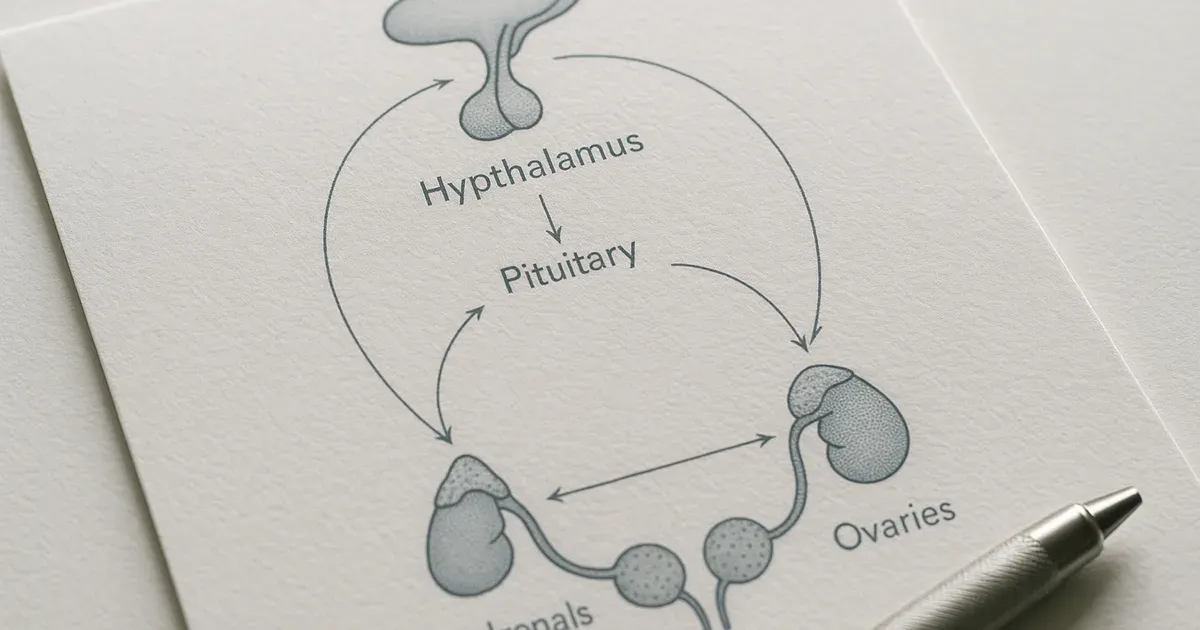
Key finding: In multivariate analyses across 15 years of data, estrone glucuronide, FSH, and testosterone were the best combined predictors of overnight cortisol — outperforming perceived stress, mood symptoms, sleep complaints, income, social support, and BMI.
5. Hot Flashes Are Both a Symptom and a Cortisol Trigger
Early laboratory research showed cortisol rises coincide precisely with hot flashes measured by sternal skin conductance and temperature changes. The Seattle study confirmed that more severe hot flashes were associated with higher overnight cortisol levels. Each hot flash is, in physiological terms, a mini stress event — activating the same HPA pathways as an external stressor. Actionable takeaway: Reducing hot flash frequency through evidence-based interventions may create a secondary benefit of dampening overnight cortisol spikes — worth discussing with your healthcare provider. If you are tracking symptoms, consider logging hot flash severity alongside sleep quality for a clearer picture of your stress hormone burden.
6. The Late Menopausal Transition Stage Is a Distinct Tipping Point
The late stage of the menopausal transition — defined by missed periods with cycle lengths exceeding 60 days — represents a physiologically distinct window, not just a gradual slide. The Seattle study noted that overnight cortisol rises were particularly evident as women moved from early to late transition stages. During this same period, women in similar cohorts showed higher total cholesterol, elevated LDL-C, and greater VLDL levels, suggesting that rising cortisol may be one mechanism linking the late transition to increased metabolic and cardiovascular risk. Actionable takeaway: If your cycles have started skipping — not just lengthening — treat this as a clinical moment to assess your broader metabolic profile, not just your reproductive hormones.

7. Perceived Stress and Social Factors Matter Less Than Biology (But They Still Matter)
One of the most counterintuitive findings from the Seattle study was that perceived stress, role burden, income adequacy, social support, employment, and even history of sexual abuse had little relationship to overnight cortisol once biological hormonal indicators were included in the model. This does not mean psychosocial stress is irrelevant — it means the biological hormonal milieu of the menopausal transition is so powerful that it can override the cortisol signal that stress alone would produce. Actionable takeaway: If you are doing everything "right" — managing stress, sleeping well, eating carefully — and still feeling the effects of high cortisol, do not blame yourself. The hormonal architecture of the transition itself is a primary driver, and that requires a biological, not just a behavioural, response.
The bottom line is that cortisol during the menopausal transition is driven primarily by the integrated activity of E1G, FSH, and testosterone — not by how stressed or unhealthy your lifestyle is. Catecholamines amplify the signal, hot flashes trigger acute spikes, and the late transition stage marks a measurable escalation point. Knowing these seven drivers means you can ask smarter questions, request more targeted testing, and stop blaming yourself for a biological process that is happening regardless of your stress management routine.