7 Fiber Macro Mistakes Wrecking Your Gut Health
Ignoring fiber macros damages your gut health and microbiome. Discover 7 critical mistakes — and how to fix them fast.


You're hitting your protein targets, tracking your carbs religiously, and still feeling sluggish, bloated, or constipated. The culprit is almost always the macro everyone ignores: fiber. Most people treat fiber as an afterthought — and their gut pays the price. If your digestion, energy, or even mood feels off, these seven fiber macro mistakes are worth reading right now.
Research published in leading nutrition journals consistently shows that fewer than 5% of Americans meet their daily fiber recommendations — yet fiber directly shapes your gut microbiome, influences the gut-brain axis, and determines how well every other macro you eat actually works.

1. You Have No Idea What Your Fiber Macro Should Actually Be
Setting a random fiber goal — or no goal at all — is the most common mistake. Instead of picking an arbitrary number, base your fiber intake on daily calories using the formula 14g of fiber per 1,000 calories consumed. For a person eating 2,000 calories, that's 28g of fiber daily. This ratio keeps your digestive system and gut microbiome properly fuelled without under- or over-shooting. Actionable takeaway: Calculate your calorie target first, then multiply by 0.014 to get your personal fiber gram goal.
2. You're Ignoring the 25g Minimum Gut Health Floor
Smaller or lighter individuals often fall below safe fiber thresholds when using the calorie formula alone. If the 14g-per-1,000-calories calculation puts you under 25g daily, your gut microbiome diversity can suffer — and bowel health deteriorates quickly. A minimum of 25g per day is the accepted baseline for maintaining healthy gut motility and supporting beneficial bacterial populations. Actionable takeaway: Never dip below 25g daily, regardless of what the formula says — treat it as a non-negotiable floor.
3. You're Assuming Vegetables Give You Enough Fiber
Leafy greens are nutritional powerhouses, but they are surprisingly poor fiber sources by volume. Lettuce, spinach, and many green vegetables contain minimal fiber relative to how much you eat — so a plate full of salad can still leave your gut microbiome starved of fermentable material. This is one of the most common misconceptions in macro tracking. Actionable takeaway: Prioritise higher-fiber plant foods like lentils, beans, oats, and peas alongside your greens, and track fiber grams specifically rather than assuming vegetable volume equals fiber adequacy.
4. You're Not Balancing Soluble and Insoluble Fiber
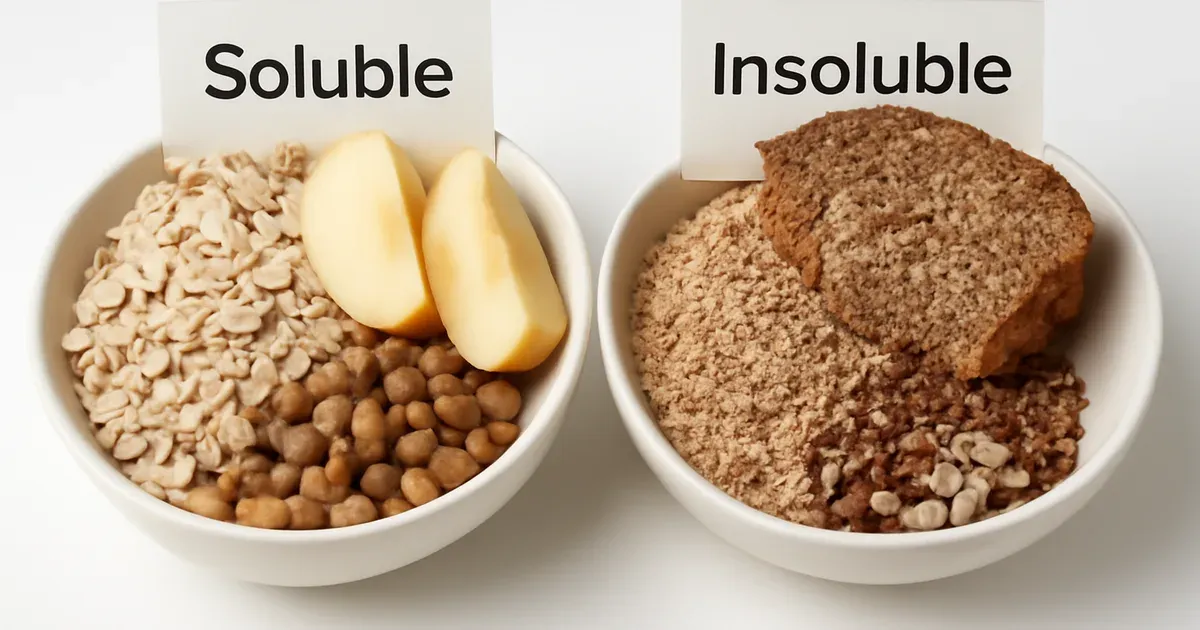
Your gut microbiome needs both types of fiber — and most people are lopsided toward one or the other. Soluble fiber, found in fruits, oats, beans, and lentils, dissolves in water and is fermented by gut bacteria, producing short-chain fatty acids that directly feed gut-brain signalling pathways. Insoluble fiber, found in bran, wholegrain bread, brown rice, and seeds, moves through the digestive tract largely unchanged, adding bulk and keeping transit time healthy. Actionable takeaway: At each meal, aim to include at least one source from each category — an apple with oatmeal in the morning, or brown rice with lentils at dinner.
Quick stat: The gut microbiome contains roughly 100 trillion microorganisms. Fiber is their primary fuel source. When you under-eat fiber, beneficial bacteria populations decline within 24–48 hours — with measurable effects on mood, immunity, and digestion.
5. You're Eating High Protein Without Increasing Fiber
High-protein diets are one of the leading dietary causes of constipation — and most people never connect the two. Protein-rich foods like chicken, beef, eggs, and whey are virtually fiber-free, meaning the more protein you eat, the more your gut microbiome is deprived of fermentable fuel. This imbalance slows gut motility, reduces microbial diversity, and can impair the gut-brain axis — affecting mood and cognitive clarity alongside digestion. If you're on a high-protein diet, you should exceed the standard 14g-per-1,000-calorie target. Actionable takeaway: For every additional 50g of protein above your baseline, consciously add one high-fiber food serving to your daily plan.
6. You're Counting Total Carbs Instead of Tracking Fiber Separately
Lumping fiber into your total carb count makes it nearly invisible in your tracking — and invisible things don't get managed. Nutrition labels include fiber within total carbohydrate figures, which works fine for beginners. But if you're serious about gut health optimisation, tracking fiber as its own line item gives you the feedback loop you need. Net carbs (total carbs minus fiber) matter for energy calculations; fiber grams matter for microbiome and digestive health. Actionable takeaway: Use a nutrition tracking app that shows fiber separately, and check your daily fiber total as a dedicated metric — not a footnote inside your carb count.
7. You're Not Using Fiber Supplements When Diet Falls Short
There is a persistent myth that supplemental fiber is somehow inferior or "cheating" — it isn't. When whole-food sources fall short, natural fiber supplements like psyllium husk offer a clinically validated way to maintain gut microbiome diversity and bowel regularity. Psyllium husk is a soluble fiber that feeds beneficial gut bacteria, supports the gut-brain axis by producing short-chain fatty acids, and has strong evidence behind its cardiovascular and digestive benefits. Actionable takeaway: If you consistently fall short of your fiber macro target despite eating vegetables, add 5–10g of psyllium husk daily to bridge the gap — mix it into water, smoothies, or oatmeal.

Getting your fiber macros right is not complicated — but it does require intentionality. Start with the 14g-per-1,000-calorie formula, respect the 25g minimum floor, balance soluble and insoluble sources, and adjust upward if you eat high protein. Your gut microbiome, your digestion, and your gut-brain axis will all reflect the change within days. Small, consistent adjustments to fiber intake consistently outperform expensive supplements or dramatic dietary overhauls.
Frequently Asked Questions
Is fiber really a macronutrient like protein, carbs, and fat?
Fiber is technically classified as a type of carbohydrate, but some nutrition experts argue it deserves its own macronutrient category. Unlike other carbohydrates, fiber is not fully digested or absorbed in the small intestine — instead it travels to the large intestine where it feeds gut bacteria and supports the gut microbiome. Its distinct behaviour and health benefits set it apart from standard carbs.
How does fiber affect the gut microbiome and gut-brain axis?
Fiber is the primary fuel source for beneficial gut bacteria. When gut bacteria ferment soluble fiber, they produce short-chain fatty acids like butyrate, which communicate directly with the brain via the gut-brain axis. Low fiber intake reduces microbial diversity, which is linked to increased inflammation, poor mood, and impaired cognitive function.
Should I subtract fiber from carbs when tracking macros?
Beginners are better off counting total carbs — the math involved in calculating net carbs (total carbs minus fiber) adds unnecessary complexity early on. Advanced trackers may prefer net carbs for a more precise energy picture. Either way, always track fiber as its own separate metric to ensure gut health targets are actually being met.
Can I get enough fiber from vegetables alone?
Not reliably. Many popular vegetables — particularly leafy greens like lettuce and spinach — contain surprisingly low amounts of fiber per serving. High-volume vegetable eaters can still fall well short of their fiber macro goals. Beans, lentils, oats, and whole grains are far more fiber-dense and should anchor your fiber strategy.
What is the best fiber supplement for gut health?
Psyllium husk is one of the most well-researched natural fiber supplements. It is a soluble fiber that feeds beneficial gut bacteria, supports regularity, and has documented benefits for cardiovascular health. It mixes easily into liquids or food. Start with 5g per day and increase gradually to avoid digestive discomfort as your gut microbiome adjusts.