My Hormonal Acne Cleared Up When I Fixed My Gut — Here's Exactly What I Did
For six years I had painful cystic acne on my jaw and chin. Antibiotics helped, then stopped. Retinol helped, then plateaued. The thing that finally cleared my skin wasn't a new product — it was fixing my gut.


For six years, I had a cystic spot on my jaw that never fully left. One would heal; another would form two centimetres to the left, a deep, painful lump that took two weeks to surface and another two to fade. My lower face was a permanent rotation of purple marks and active spots, always concentrated in the same place.
I tried everything in the standard playbook. Three courses of antibiotics over four years — the third one barely touched it. Adapalene retinoid, which helped with texture but did nothing for the deep cysts. A very expensive appointment with a dermatologist who told me to try a fourth antibiotic, or consider Roaccutane (isotretinoin), which I was reluctant to do.
What actually cleared my skin was something that dermatologist never mentioned: my gut.
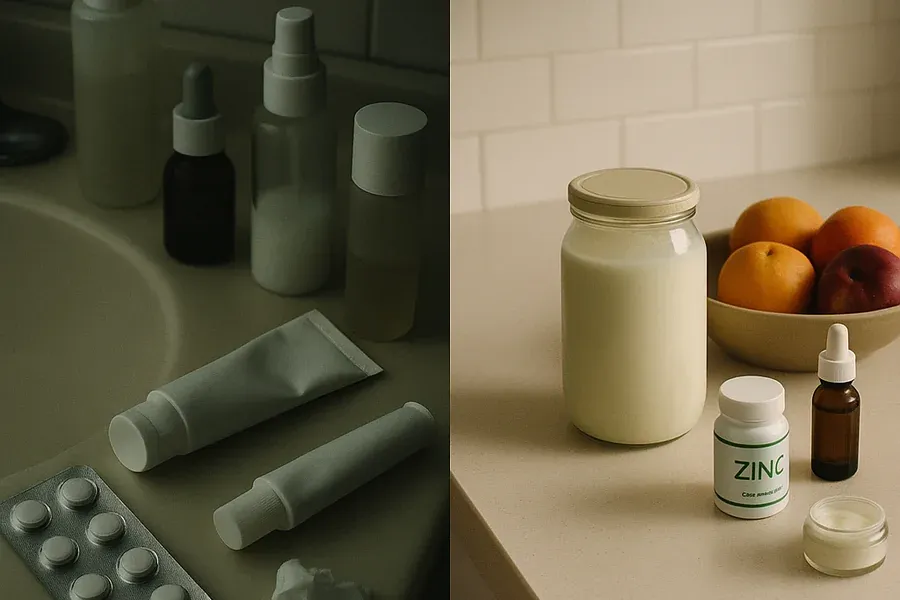
The Clue I Ignored for Years
Looking back, the gut connection was hiding in plain sight. My acne had always been worse in the week after I'd eaten badly — the holiday weeks, the Christmas period, the stressful months when I was living on sandwiches and coffee. I assumed stress was the cause and dismissed the food variable.
I also had what I thought was just a sensitive stomach. I was often bloated after meals, had irregular bowel movements, and felt inexplicably tired in the afternoons. I'd filed all of this under "just how I am." It never occurred to me that it was related to the state of my skin.
The connection clicked during a conversation with a nutritional therapist friend who mentioned that the gut microbiome regulates oestrogen metabolism — and that disrupted gut flora can cause oestrogen to be reabsorbed rather than excreted, contributing to the hormonal imbalance that drives cystic jawline acne specifically.
I'd never heard this. I went home and spent a weekend reading about the gut-skin axis, and what I found sent me back to the starting point with an entirely different understanding of what was going on.
→ The full science: What's Really Causing Your Adult Acne
What I Changed First: Diet
I started with diet because it was the most controllable variable. Based on what I'd read about the research, I made three changes simultaneously:
Cut skimmed milk. I'd been drinking two large lattes a day with skimmed milk — my one supposed health virtue. I switched to oat milk with no expectation that it would matter. Within three weeks, the frequency of new cysts dropped noticeably. This was the first thing I'd done in six years that produced a visible change within a month.
Reduced refined carbohydrates. Not eliminated — I wasn't interested in an extreme approach — but I shifted my daily carb intake toward whole grains and away from white bread and pasta. I started eating breakfast with protein (eggs, or Greek yoghurt) rather than cereal or toast, which reduced the morning blood sugar spike I'd apparently been having every day.
Added fermented foods. I started adding a tablespoon of kimchi to lunch and dinner, and having kefir in the evenings. I'll be honest: I found both slightly unpleasant at first. By week three, I'd grown to genuinely like them.
I expected nothing from these changes and was quietly stunned when they appeared to be doing something.
Adding Supplements
Three months in, with the dietary changes already producing measurable improvement, I introduced supplements. I tried to be deliberate about this — one at a time, so I could actually attribute what was helping.
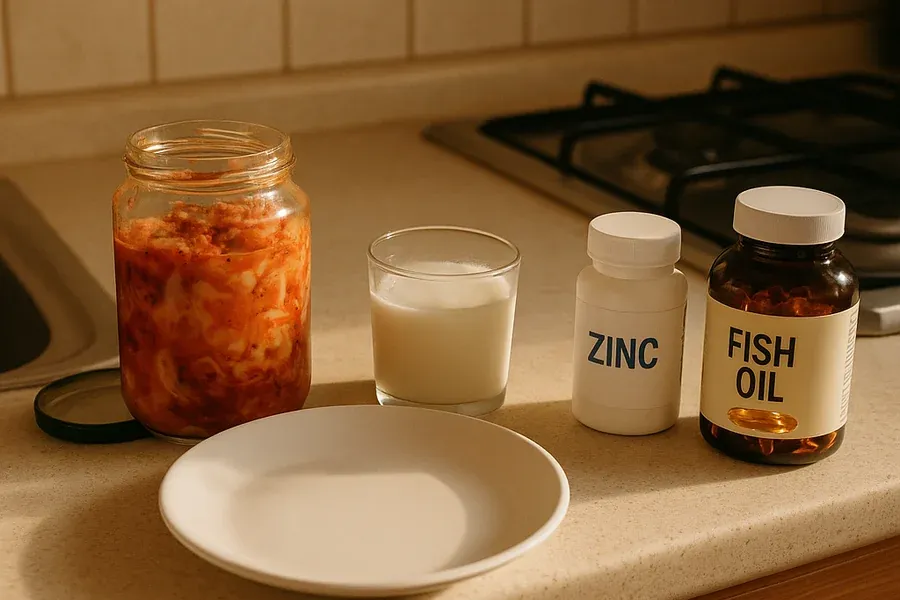
Zinc picolinate (25mg daily). I introduced this first. Within six weeks I noticed that the spots that did appear were smaller and resolved faster. The deep cysts that had been my main issue became noticeably less frequent. I've since read that zinc inhibits the bacteria central to acne inflammation and reduces sebum production directly — which maps exactly to what I experienced.
Vitamin D3 (2,000 IU daily). I added this after getting a blood test that confirmed I was deficient (not uncommon in the UK). I can't attribute specific skin changes to this given I was already seeing improvement, but my overall energy stabilised noticeably and my immune function — I'd been getting frequent colds — improved.
Omega-3 fish oil (1,500mg EPA+DHA daily). The last addition, around month five. I noticed my skin became less reactive — the redness that had accompanied every spot reduced, and post-inflammatory marks faded more quickly. My digestive symptoms also improved around this time, which may have been the omega-3s reducing gut inflammation.
→ Full supplement and treatment guide: How to Clear Hormonal Acne from the Inside Out
The Skincare Shift
At the same time as the internal changes, I simplified my skincare dramatically. I'd been over-applying, layering multiple acids, and essentially doing daily battle with my skin barrier — which, I later understood, was actually worsening the cycle of inflammation.
I stripped back to four products: a gentle cleanser (no foaming, no fragrance), adapalene every third night, niacinamide serum in the morning, and SPF. That was it for the first three months.
The simplification itself seemed to help. My skin became less red and less reactive. The adapalene, which had barely touched the deep cysts before, started working more effectively now that my skin wasn't chronically inflamed from the inside.
If you've started a new product and your skin has dramatically worsened, I want to flag: that may be purging (temporary), or it may be a reaction. I went through both and misidentified them more than once.
→ How to tell the difference: Skin Purging vs Breaking Out
Month by Month: What the Timeline Looked Like
Month 1: Dietary changes. Notable reduction in new cysts within three weeks. Still some active spots, but fewer and less severe. Gut symptoms (bloating) beginning to reduce.
Month 2–3: Zinc supplementation added. Spots resolving faster. Pre-menstrual flare still present but significantly less severe. Skincare simplified.
Month 4: Vitamin D added. Skin settling into a new normal — clear most of the time, with one to two small spots pre-period rather than six to eight deep cysts.
Month 5: Omega-3s added. Skin markedly less reactive. Post-inflammatory hyperpigmentation fading. First full month without a cyst.
Month 6: Skin essentially clear. Pre-menstrual cycle still causes some congestion but nothing inflammatory. The purple marks from six years of cysts are gradually fading.
I want to be honest that month three was hard. Things were better but still imperfect, and I'd had a particularly bad flare around a stressful work period that made me question whether I was imagining the improvement. I nearly went back to the antibiotics. I'm glad I didn't.
What I Think Was Actually Happening
My read on what drove the change, based on what I've since read about the gut-skin axis:
The skimmed milk was likely contributing to hormonal imbalance — milk contains hormonal precursors and whey protein, which drives insulin and IGF-1 spikes that promote androgen production. Cutting it reduced a significant androgen stimulus.
The fermented foods and dietary changes improved my gut microbiome diversity, which improved my oestrogen metabolism — meaning excess oestrogen was being properly cleared rather than reabsorbed and recycling through my system.
The zinc directly interrupted the acne cycle at the level of bacterial activity and sebum production.
Together, they addressed three of the four main drivers of my specific acne pattern. The topical retinoid — which had done 20% of the job for two years — was suddenly doing 80% of the job, because the internal conditions it needed had been created.
What I'd Do Differently
If I were starting this process now, I'd do it in the right order more deliberately: diet first, then gut support, then targeted supplements, then simplify skincare. I wasted two years doing it in the wrong order — throwing topical products at an internal problem and wondering why they weren't working.
I'd also get a blood test earlier to check vitamin D and zinc status, rather than supplementing blind.
And I'd read the research on the gut-skin axis much sooner. The information is there. It's just not what most dermatologists lead with.
→ The complete science: Hormonal Acne and the Gut-Skin Axis
→ Understanding the drivers: What's Really Causing Your Adult Acne
→ The step-by-step approach: How to Clear Hormonal Acne from the Inside Out
→ Before you start a new product: Skin Purging vs Breaking Out