How to Set Fiber Macros the Right Way
Learn how to calculate your fiber macros using a simple formula, choose the right foods, and avoid the most common mistakes — step by step.

You're hitting your protein. You're tracking your calories. Yet something still feels off — bloating, sluggish digestion, or that nagging feeling that your diet isn't quite complete. You've tried adding more salads, drinking more water, maybe even buying a greens powder that tasted like a garden shed.
Most macro guides skip fiber entirely or treat it as an afterthought. That's a problem. Fiber is one of the most powerful tools for gut health, satiety, and long-term metabolic function — and most people have no idea how much they actually need.
This guide gives you a clear, step-by-step method to calculate and hit your fiber macros every day, without complex tracking or sacrificing the foods you love.
Why Fiber Problems Happen in the First Place
Most macro frameworks were built around three nutrients: protein, carbohydrates, and fat. Fiber rarely gets its own target, even though some nutrition experts argue it deserves the title of the fourth macronutrient. The result? People hit their carb numbers but ignore fiber entirely — and their gut pays the price.
High-protein diets make this worse. Foods that are dense in protein — chicken breast, eggs, whey, Greek yogurt — contain almost no fiber. The more your diet skews toward protein, the more fiber tends to disappear from your plate without you noticing.
There's also a common misconception about vegetables. Leafy greens like lettuce and many popular salad vegetables are surprisingly low in fiber per serving. Eating a large salad every day can feel virtuous, but it won't reliably hit a meaningful fiber target. Without a specific fiber goal, most people are chronically under-consuming one of the body's most important dietary inputs.
Step 1: Understand What Fiber Actually Does in Your Body
Fiber isn't just roughage — it's a functional nutrient with a direct impact on your health. Unlike other carbohydrates, fiber is not fully digested and absorbed in the small intestine. Instead, it travels further and delivers a completely different set of benefits.
There are two main types of fiber, and both matter:
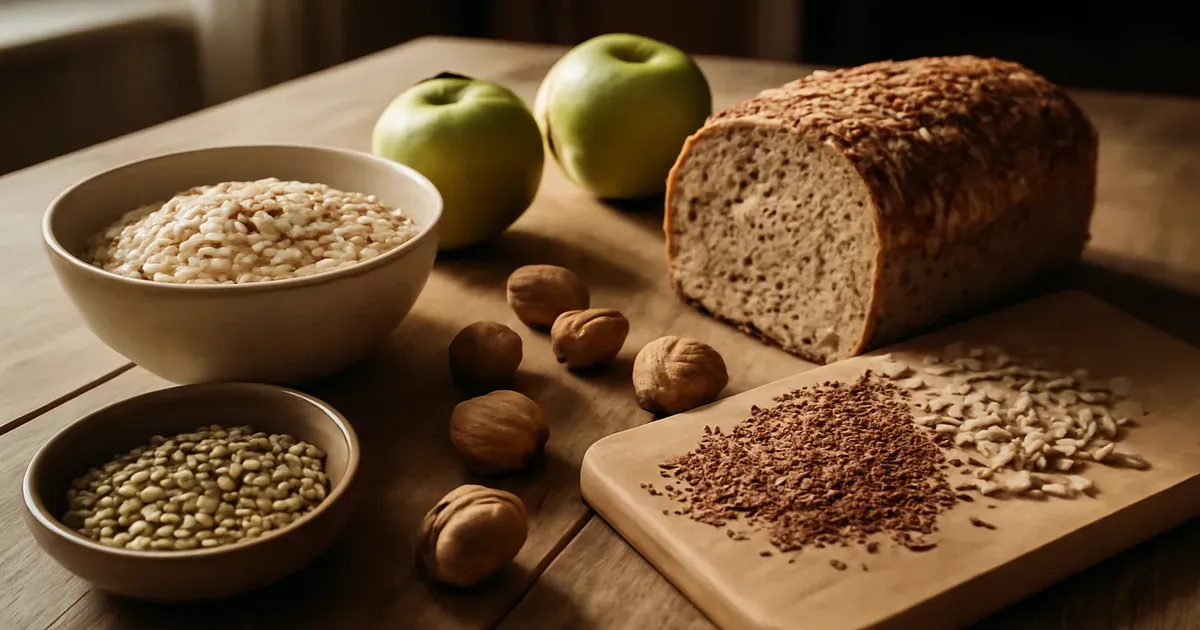
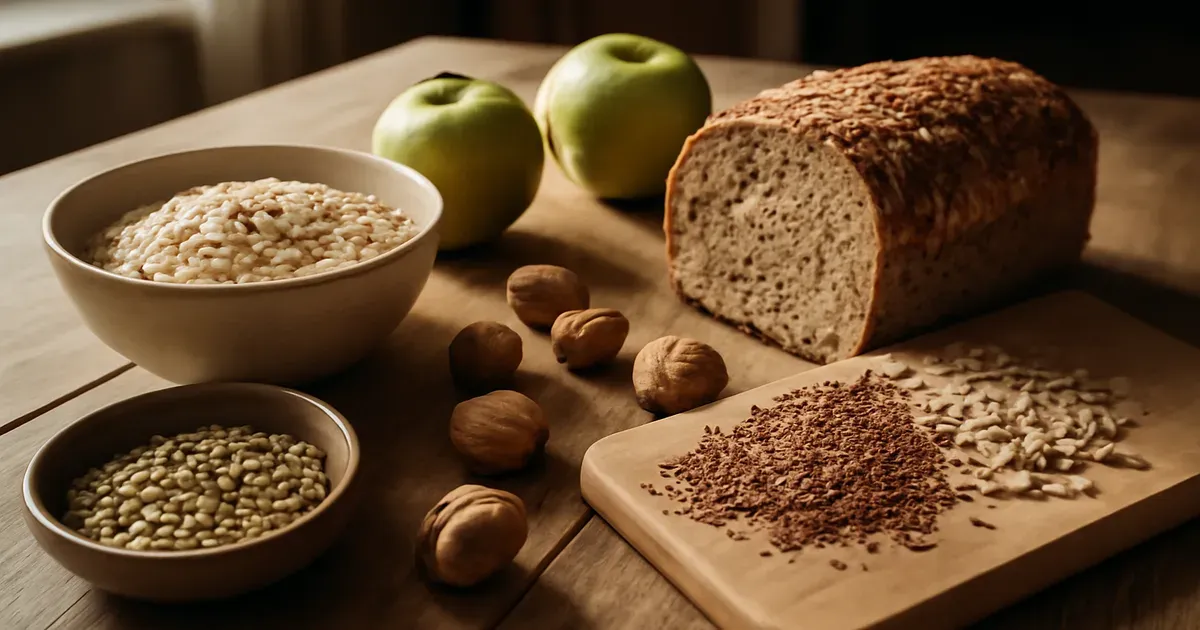
- Soluble fiber dissolves in water and is fermented by gut bacteria as it passes through your digestive tract. It absorbs water, softens waste, and aids in smooth digestion. Key sources include oats, beans, lentils, apples, peas, barley, and potatoes.
- Insoluble fiber does not dissolve in water and passes through your digestive system largely unchanged. It adds bulk to stool and keeps things moving. Key sources include bran, wholemeal bread, brown rice, whole grain cereals, nuts, seeds, and edible fruit peels.
Together, these two types support a healthy gut microbiome, promote feelings of fullness after meals, and regulate digestion. Soluble fiber, in particular, plays a role in blood sugar stabilisation and cholesterol management. Getting a mix of both from food — rather than relying on one type alone — is the smarter long-term strategy.
Pro tip: Don't stress about the soluble vs. insoluble split. Eat a variety of whole foods and you'll naturally get both.
Step 2: Calculate Your Personal Fiber Macro Target
Rather than using a one-size-fits-all number, your fiber target should scale with your daily calorie intake. The formula used by experienced nutrition coaches is straightforward:
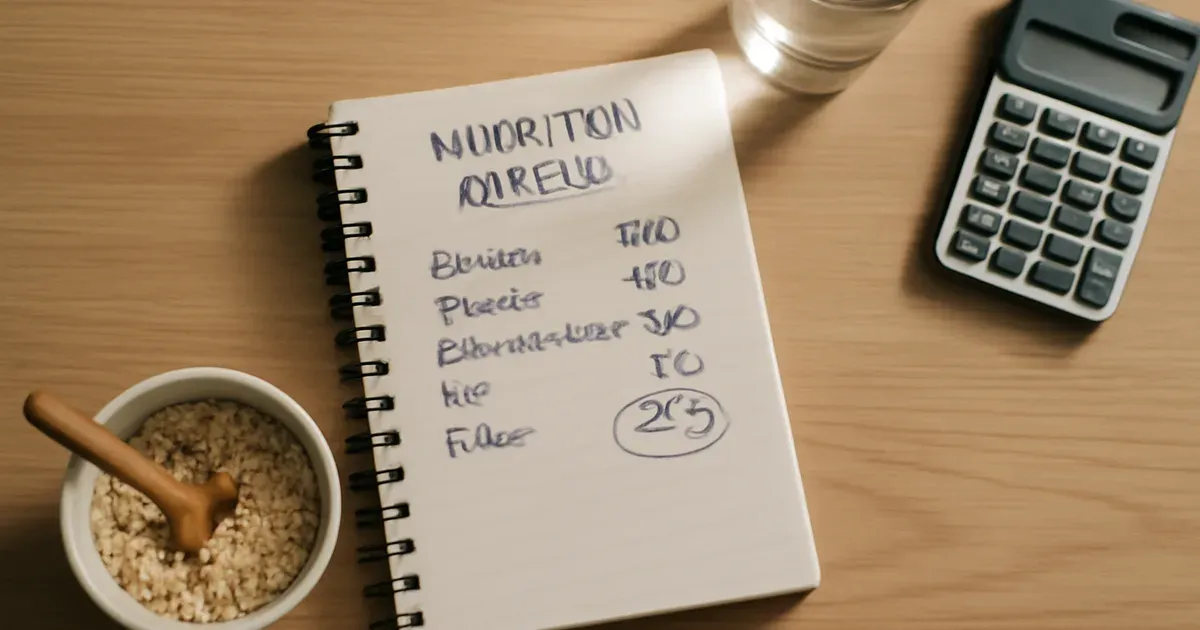
14 grams of fiber per 1,000 calories consumed
Here's how to apply it:
- Take your daily calorie target (e.g. 2,730 calories)
- Divide it by 1,000 (e.g. 2,730 ÷ 1,000 = 2.73)
- Multiply by 14 (e.g. 14 × 2.73 = 38 grams of fiber)
Example — a 195 lb male with a 2,730 calorie target: His full macro breakdown might look like this: 195g protein, 76g fat, 317g carbohydrate, and 38g fiber. Fiber now has its own dedicated target rather than being left to chance.
There is one important caveat for smaller or lighter individuals. If the formula produces a number below 25 grams, default to 25 grams per day as a minimum floor. This baseline protects bowel health regardless of calorie intake. Never go below it.
If you're on a high-protein diet, adjust upward. Since protein foods are almost entirely fiber-free, the standard 14g per 1,000 calories may not be sufficient. Aim higher — constipation is a common and uncomfortable side effect of high-protein eating when fiber is neglected.
Step 3: Build Your Daily Meals Around Fiber Targets
Now that you have a number, the next step is making it practical. Most people find it easier to build fiber into their meals proactively rather than scrambling to "fix" their intake at the end of the day.
Here's a simple approach to hitting your fiber target consistently:
- Anchor meals with high-fiber carbohydrates. Oats at breakfast, lentils or beans at lunch, and brown rice or whole grain bread at dinner covers a significant portion of most fiber targets without much effort.
- Add legumes regularly. A 100g serving of cooked lentils contains around 8g of fiber. Beans, peas, and chickpeas are similarly dense. These are the most efficient fiber sources available.
- Don't rely on leafy salad greens alone. Lettuce, cucumber, and similar vegetables are high in volume but low in fiber. Swap some leafy greens for roasted vegetables, edible-skin fruits, or cooked cruciferous vegetables like broccoli and Brussels sprouts.
- Use fruit strategically. Apples (with skin), pears, raspberries, and dried fruit are excellent soluble fiber sources that also satisfy sweet cravings.
If you consistently fall short despite eating well, supplementing with a natural fiber like psyllium husk is a legitimate and evidence-supported option. Psyllium husk is tasteless, mixes easily with water, and provides a meaningful fiber boost without adding significant calories. It's not a replacement for whole food fiber, but it's a practical tool when diet alone isn't enough.

Step 4: Decide Whether to Track Net Carbs or Total Carbs
When you start tracking fiber as a macro, a practical question comes up: should you subtract fiber from your total carbohydrate count? This is the concept of "net carbs" — the carbohydrates your body actually digests and uses for energy.
Because fiber isn't absorbed and doesn't provide usable energy in the same way other carbohydrates do, some trackers prefer to subtract fiber grams from total carb grams to get a cleaner picture of their energy intake.
The honest answer: it depends on your experience level.
- If you're new to tracking macros, don't bother with net carbs yet. Nutrition labels include fiber within the total carb count, and the mental overhead of subtracting fiber on every food item adds unnecessary friction. Track total carbs and hit your fiber target as a separate number.
- If you're experienced with macro tracking, switching to net carbs can give you a more precise view of your actual carbohydrate intake. It becomes especially relevant on lower-carb eating patterns where fiber from vegetables and legumes would otherwise eat into your carb budget.
The key principle: fiber should always have its own tracked target regardless of whether you use total or net carbs. Treating it as an invisible sub-component of your carbs is what causes people to under-eat it for months.
What to Expect Week by Week
Week 1: You'll likely notice digestive changes quickly — either improvement or temporary bloating as your gut microbiome adjusts to increased fiber. This is normal. Increase fiber gradually if you're coming from a low baseline.
Week 2–3: Digestion begins to normalise. Many people report more consistent energy levels and reduced afternoon hunger as improved satiety from fiber takes effect. Bowel regularity often improves noticeably.
Week 4 onward: The longer-term benefits accumulate. A well-fed gut microbiome, better blood sugar stability, and reduced cravings are the compounding rewards of consistent fiber intake. At this point, hitting your fiber target should feel habitual rather than effortful.

Mistakes That Slow Your Progress
- Using a flat, generic fiber number. Recommending "25–38g" for everyone ignores the fact that calorie intake varies widely. Scale your target to your intake using the 14g per 1,000 calorie formula.
- Assuming salads cover it. Leafy greens are healthy but not reliable fiber sources. Volume and fiber content are not the same thing.
- Ignoring fiber on high-protein diets. This is the most common oversight. The higher your protein intake, the more deliberately you need to seek fiber. They work in opposite directions.
- Tracking fiber as part of carbs only. When fiber hides inside your carb total without its own target, it almost always gets under-consumed. Give it a dedicated number.
- Jumping to maximum fiber too quickly. If you're currently eating 10g per day and you jump to 38g overnight, expect significant digestive discomfort. Increase by 5g per week until you reach your target.
What Can Help You Get There Faster
A macro tracking app with fiber logging. Most modern apps (Cronometer, MacroFactor, MyFitnessPal) allow you to set a custom fiber goal and track it as a standalone target. Enable this feature — it changes your awareness immediately.
A quality fiber supplement. Psyllium husk is the most widely studied and practically useful option. It's inexpensive, neutral in flavour, and provides roughly 5–7g of soluble fiber per teaspoon. Use it as a bridge when food-based fiber falls short, not as your primary source.
A structured macro calculator. Starting from a well-calibrated calorie and macro target makes the 14g per 1,000 calorie formula immediately applicable. Without a calorie baseline, you can't calculate your fiber target accurately. Resources like the GutBrain.news macro calculator give you a personalised starting point that includes fiber from the outset.
Summary: Your Fiber Macro Checklist
✅ Understand that fiber behaves differently to other carbohydrates and deserves its own macro target ✅ Learn the two types — soluble (oats, legumes, fruit) and insoluble (bran, wholegrains, seeds) ✅ Calculate your fiber target using 14g per 1,000 daily calories ✅ Set a minimum floor of 25g per day regardless of calorie intake ✅ Increase fiber beyond the formula if you follow a high-protein diet ✅ Build meals around legumes, wholegrains, and skin-on fruits rather than relying on leafy greens alone ✅ Consider psyllium husk supplementation if food alone doesn't hit your target ✅ Decide whether to track total carbs or net carbs based on your experience level ✅ Increase fiber gradually — 5g per week — to avoid digestive discomfort
Frequently Asked Questions
Is fiber really a macronutrient?
Fiber is technically classified as a type of carbohydrate, but a growing number of nutrition experts argue it deserves to be considered the fourth macronutrient. This is because fiber behaves entirely differently to other carbohydrates in the body — it isn't digested and absorbed in the small intestine, it feeds the gut microbiome, and it provides distinct health benefits not shared by other carbs. Whether or not it holds official macronutrient status, it warrants its own daily target.
How much fiber should I eat on a high-protein diet?
On a high-protein diet, you should aim for more than the standard 14g per 1,000 calories. Protein-dense foods contain almost no fiber, so the higher your protein intake, the more deliberately you need to source fiber elsewhere. Constipation is a well-documented side effect of high-protein eating when fiber is neglected. Prioritise legumes, wholegrains, and psyllium husk supplementation to compensate.
Should I subtract fiber from my carbs when tracking macros?
If you're new to macro tracking, don't subtract fiber from carbs yet. Track total carbs and monitor fiber as a separate goal. Once you're experienced with the system, switching to net carbs (total carbs minus fiber grams) gives a more accurate picture of digestible carbohydrate intake — particularly useful on lower-carbohydrate eating patterns.
What are the best food sources of fiber?
The most fiber-dense foods include lentils, beans, chickpeas, oats, barley, whole grain cereals, bran, nuts, seeds, apples, pears, and raspberries. Note that high-volume foods like lettuce and cucumber are low in fiber despite appearing filling. For reliable fiber intake, prioritise legumes and wholegrains as daily anchors rather than relying on salad vegetables.
Can I supplement fiber instead of eating it from food?
Psyllium husk is a legitimate and widely studied fiber supplement that can meaningfully close the gap between your food-based intake and your daily target. It's not a replacement for whole food sources, which provide additional micronutrients and prebiotic diversity. Think of it as a practical backup tool — especially useful on days when meals skew heavily toward protein and fat.