Menopause Belly Fat: Why It Happens & How to Fight It
Learn why menopause belly fat forms as estrogen drops and metabolism slows — and the proven diet and exercise strategies to fight back.


You're eating the same foods, moving just as much — yet your waistband keeps getting tighter. If you're in the years surrounding menopause and watching extra weight settle stubbornly around your middle, you're not imagining it. There's a real, physiological reason menopause belly fat behaves differently from the weight you may have gained at other points in your life. The good news: targeted strategies can slow it down and even reverse it.

Why Menopause Causes Belly Fat to Accumulate
The shift begins with estrogen. As periods become less frequent and menopause approaches, estrogen levels fall significantly. Estrogen has long influenced where the female body stores fat — typically directing it toward the hips and thighs during reproductive years. When estrogen drops, that distribution pattern changes, and the abdomen becomes the new preferred storage site.
This is not a willpower problem — it's biology. The body isn't malfunctioning; it's responding to a hormonal signal that has shifted. Understanding that menopause belly fat is driven by these hormonal changes, rather than lifestyle failure, is the first step toward addressing it effectively.
The abdomen isn't just a cosmetic concern. Visceral fat — the deep fat that accumulates around internal organs in the belly — is metabolically active. Higher amounts are associated with increased risk for cardiovascular disease, type 2 diabetes, and other chronic conditions. That makes managing menopause belly fat a genuine health priority, not vanity.
The Muscle and Metabolism Connection
Estrogen isn't the only factor at play. Alongside hormonal shifts, muscle mass naturally begins to decline in the years surrounding menopause. Muscle tissue burns calories even at rest, so losing it means your resting metabolic rate — how many calories your body uses just to keep itself running — drops as well.
A slower metabolism means fewer calories burned around the clock. Even if your diet stays identical, your body is now using less energy than it was before. The calorie surplus, however small, adds up over months and years, and because of where fat is now being stored, the belly is where it shows up first.
This double effect — changing fat distribution plus metabolic slowdown — is what creates the "menobelly" or "menopot" that many women describe. Both factors need to be addressed for any strategy to be effective. Focusing on diet alone without supporting muscle mass will only get you so far.
How Protein Intake Helps Counter Menopause Belly Fat
Protein is the most important dietary lever you can pull. Eating enough protein gives your body the raw materials it needs to build and maintain muscle tissue. More muscle means a higher metabolism, which helps offset the metabolic slowdown that accompanies menopause.
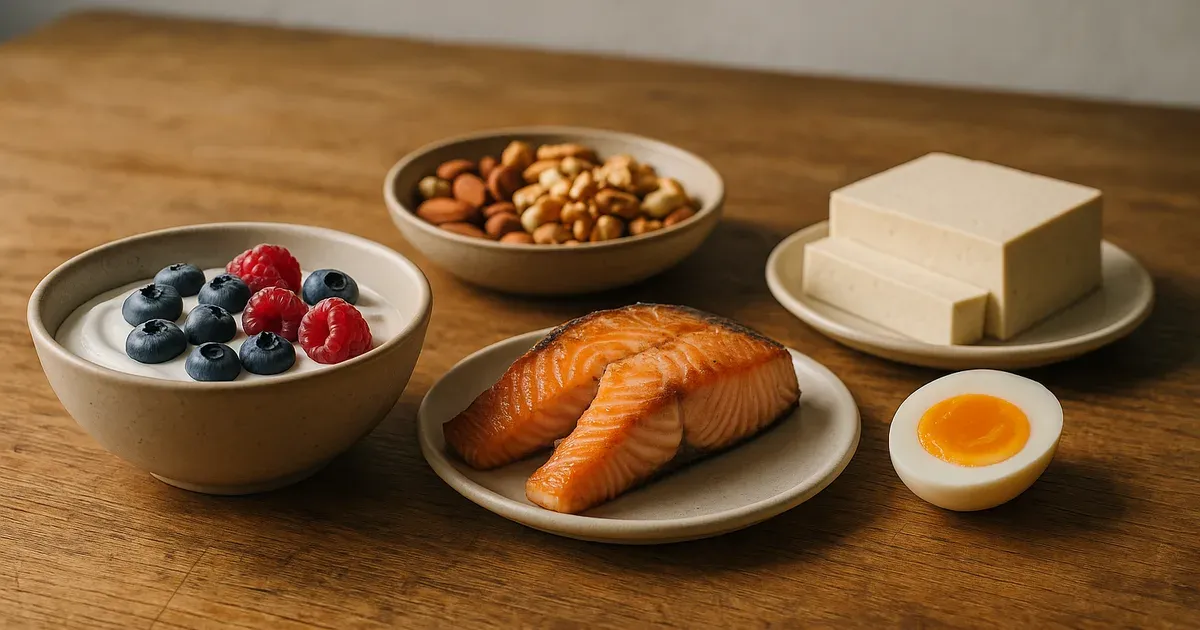
The goal is to include protein-rich foods at every meal and snack — not just dinner. Spreading protein intake throughout the day is more effective for muscle protein synthesis than consuming it all in one sitting. Think Greek yogurt at breakfast, a handful of nuts mid-morning, fish at lunch, and poultry or tofu at dinner.
Here are some of the best protein sources to prioritise during and after the menopause transition:
- Greek yogurt — high in protein and also provides calcium for bone health
- Tofu and edamame — plant-based options rich in protein and phytoestrogens
- Fish (salmon, tuna, cod) — lean protein with the added benefit of omega-3 fatty acids
- Poultry (chicken, turkey) — versatile, low-fat protein sources
- Nuts and nut butters — protein plus healthy fats that support satiety
- Legumes (lentils, chickpeas, black beans) — budget-friendly, high-fibre protein options
- Eggs — one of the most complete protein sources available
Aim for a palm-sized portion of protein at each eating occasion. Many women find they were significantly under-eating protein before making a conscious effort to increase it. Even modest increases can make a meaningful difference over time.

Strength Training: The Most Effective Exercise for Menopause Belly Fat
Not all exercise is created equal when it comes to menopause belly fat. Cardio has benefits, but resistance and strength training are the most powerful tools for preserving and rebuilding the muscle mass that menopause erodes. More muscle equals a faster metabolism — and that's the metabolic engine that works against belly fat accumulation.
You don't need a gym membership or heavy equipment to start. Bodyweight exercises like squats, push-ups, lunges, and planks can build meaningful strength when performed consistently. Aim for at least two to three strength sessions per week, with a day of rest in between to allow muscles to recover and adapt.
Progression matters. As exercises become easier, incrementally increase the challenge — add resistance bands, try weighted variations, or increase your reps. The muscle-building stimulus comes from progressively overloading the muscle, not just repeating the same movement indefinitely.
Some effective starting exercises include:
- Squats — work the large muscle groups of the legs and glutes, burning more calories and building more mass
- Push-ups — build upper body and core strength with no equipment
- Planks — specifically target core stability, important for the abdominal area
- Resistance band rows — support posture and back strength, often neglected in at-home routines
- Glute bridges — activate the posterior chain and support lower back health
Consistency over intensity is the rule. Two moderate sessions done week after week will outperform occasional intense bursts followed by long gaps. Building the habit matters more than the weight on the bar.
Lifestyle Factors That Amplify or Reduce Menopause Belly Fat
Sleep quality deserves more attention than it usually gets in this conversation. Poor sleep — which becomes more common during the menopause transition due to night sweats and hormonal fluctuations — raises cortisol levels. Elevated cortisol specifically promotes the storage of visceral fat in the abdominal area, compounding the effects already driven by changing estrogen levels.
Stress management follows the same logic. Chronic psychological stress keeps cortisol elevated, which in turn drives fat storage around the midsection. Practices like walking, yoga, meditation, or simply protecting time for enjoyable activities can help dampen the cortisol response. Hormones like cortisol and estrogen interact in ways that make stress reduction a legitimate part of a belly fat strategy, not just a wellness platitude.
Alcohol is worth reconsidering. Many women find that alcohol tolerance shifts around menopause, and alcohol itself is calorie-dense, disrupts sleep, and can promote fat storage in the abdominal region. Reducing intake — even slightly — can have an outsized effect on belly fat compared with cutting calories elsewhere.

Frequently Asked Questions About Menopause Belly Fat
Will menopause belly fat go away on its own after menopause? Not typically. Without changes to diet and exercise habits, the fat that accumulates during the perimenopause transition tends to persist after menopause. The hormonal environment that favoured abdominal fat storage doesn't reverse once menopause is complete — which is why building new habits during perimenopause is particularly valuable.
Does hormone replacement therapy (HRT) help with belly fat? Some research suggests HRT may help mitigate the shift toward central fat storage by partially restoring estrogen levels. However, HRT decisions are complex and should be made in consultation with a healthcare provider based on individual risk profiles. It is not a standalone solution for menopause belly fat.
How long does it take to see results from strength training and higher protein intake? Most women notice measurable improvements in strength within four to six weeks, though visible body composition changes typically take longer — often three to six months of consistent effort. Patience and consistency are the defining variables.
Is the menopot inevitable? Not entirely. While the physiological drivers are real, the degree to which belly fat accumulates is strongly influenced by lifestyle. Women who maintain or increase protein intake and adopt resistance training during the perimenopause years tend to experience significantly less central fat accumulation than those who don't make changes.
The Bottom Line
Menopause belly fat is real, it's physiological, and it's driven by a combination of falling estrogen, declining muscle mass, and a slowing metabolism. Understanding the mechanism removes the self-blame and points directly toward solutions that actually work.
The core strategy is straightforward: eat more protein, do more resistance training, sleep well, and manage stress. None of these require perfection. Small, consistent improvements compound meaningfully over months. Your body is not working against you — it's responding to a new hormonal environment, and you can shape how it responds.
Starting now, wherever you are in the menopause transition, is better than waiting. The muscle you preserve or rebuild today is the metabolism you carry into next year. The choices made during perimenopause set the trajectory for the decades that follow.