Train for Your Body Type: Ecto, Endo & Meso
Learn how to train for your body type — ectomorph, endomorph, or mesomorph — with expert workout and diet strategies for real results.


You're putting in the hours at the gym and eating reasonably well — so why aren't you seeing results? The answer is likely simpler than you think. Most men are training against their own biology rather than working with it.
Every man falls into one of three body type categories: ectomorph, endomorph, or mesomorph. Each body type responds differently to training and nutrition. Understanding which one you are — and adapting your plan accordingly — is the single most effective change you can make to your fitness routine.
Celebrity personal trainer Scott Laidler breaks down exactly how to train for your body type, covering workout structure, diet strategy, and what to prioritise for real, lasting results.

What Are the Three Male Body Types?
Body type theory — sometimes called somatotype theory — divides male physiques into three broad categories. These aren't rigid boxes, and many men are a blend of two, but most have a dominant type that shapes how their body stores fat, builds muscle, and responds to exercise.
- Ectomorphs are naturally slim with narrow frames, thin wrists, and fast metabolisms. They struggle to gain both muscle and fat.
- Endomorphs carry a larger, softer frame and gain bulk easily — but fat tends to come along for the ride.
- Mesomorphs are naturally lean and athletic, gaining muscle comparatively easily while keeping fat relatively low.
Identifying your dominant body type takes honesty, but it doesn't require a specialist. Your bone structure, where you carry weight, and how your body responds to training are the clearest indicators.
Ectomorphs: How to Train and Eat to Actually Build Muscle
Do you have an ectomorph body type?
Narrow shoulders, thin wrists, and a frustrating inability to gain size — these are the hallmarks of an ectomorph. If you've been called a "hard-gainer," this is almost certainly you. Ectomorphs tend not to store excess fat, which means they often appear lean or, at worst, "skinny-fat" — low muscle with a little soft tissue sitting over the top.
"Ectomorph metabolisms are almost too efficient," says Laidler. "A high amount of calories need to be consumed in order to put on any real size."
Training strategy for ectomorphs
Lifting light will get you nowhere. Unless long-distance endurance running is your explicit goal, building muscle mass has to be the priority. Laidler recommends three heavy, short training sessions per week with ample recovery time built in between.
"Ectos can't cruise like mesomorphs," Laidler explains — meaning thinner men have to work harder not just to gain muscle, but to maintain what they already have. One cardio session per week is sufficient. With minimal fat to lose, the focus should be squarely on building size and strength.
Diet strategy for ectomorphs
Calories are your most important variable. Eating too little leads to overtraining — your body will burn through muscle tissue for fuel when energy stores run dry. Protein shakes and mass gainers are a practical way to increase caloric and protein intake without forcing down endless meals.
Compound movements performed with high-rep ranges are the training sweet spot for ectos. These multi-joint exercises — think squats, deadlifts, bench press, and rows — trigger maximum testosterone response and stimulate the most muscle fibres simultaneously.

Endomorphs: How to Lose Fat Without Sacrificing Strength
Do you have an endomorph body type?
Large frame, naturally strong, but prone to carrying excess fat — that's the endomorph reality. This is the dominant body type among rugby players and strongmen. Endomorphs can build impressive strength, but carving out visible muscle definition is a constant battle against the body's tendency to store fat.
"The biggest challenge facing an endomorph is that they find it difficult to lose fat even when exercising," says Laidler.
Training strategy for endomorphs
Cardio isn't optional — it's a non-negotiable part of the plan. Laidler recommends three cardio sessions per week to keep fat accumulation in check, paired with two weight training sessions designed to spike EPOC (Excess Post-Exercise Oxygen Consumption) — the calorie-burning effect that continues after a workout ends.
High-intensity interval training (HIIT) is the most effective tool in the endomorph's arsenal. It strips unwanted body fat while preserving functional strength. When it comes to weights, high reps are a must — but isolation exercises alone won't cut it. "Your weight training doesn't have to be total body," Laidler says, "but it shouldn't be isolation."
Diet strategy for endomorphs
Post-workout nutrition matters more for endomorphs than any other body type. Avoid carbohydrates after training — protein only. This signals the body to use stored fat for fuel during recovery rather than relying on dietary carbohydrate.
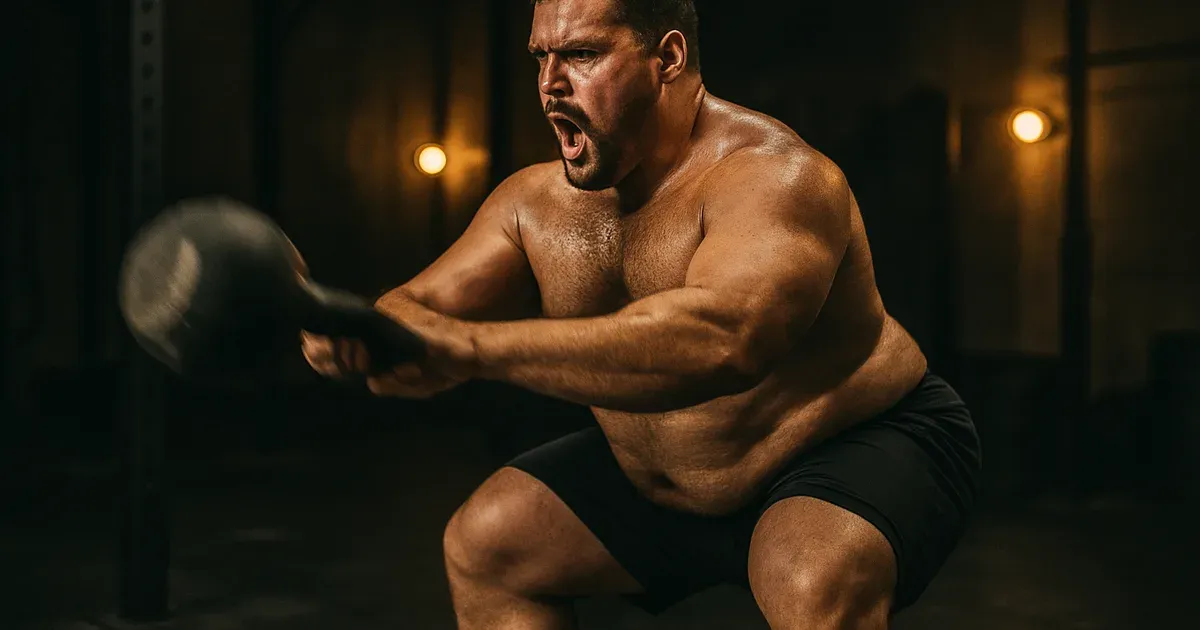
Day-to-day, high-GI carbohydrates need to be strictly limited. These fast-digesting carbs spike insulin, promote fat storage, and do very little in the way of sustained energy. A circuit-based kettlebell HIIT session — similar to the one used to prepare Joel Edgerton for the MMA film Warrior — is an ideal workout model for endomorphs looking to stay lean while building a powerful physique.
Mesomorphs: How to Train for Your Body Type Without Going Stale
Do you have a mesomorph body type?
Wider shoulders than hips, visible muscle with relatively little effort, and a body that responds quickly to training — mesomorphs are, as Laidler acknowledges, the lucky ones. They're natural athletes whose bodies both shed fat and build muscle with comparative ease.
But here's the trap: winning the genetic lottery doesn't make you immune to bad habits. A poor diet and an unstructured training plan will undermine a mesomorph just as effectively as anyone else.
Training strategy for mesomorphs
Variety is the most important principle for mesomorph training. Because mesomorphs respond well to almost every training modality — "from total body to isolation and lighter training," says Laidler — the real risk is adaptation and plateau. Switching methods regularly keeps the stimulus fresh and results consistent.
Full-body compound movements like squats, deadlifts, and overhead presses exploit the mesomorph's natural strength advantage. Volume training — think 10 sets of 10 reps — is particularly effective for building additional size, according to Laidler.
Diet strategy for mesomorphs
Eating moderately clean is enough to maintain the mesomorph physique under normal circumstances. There's no need for the extreme caloric surpluses an ectomorph requires, or the tight carbohydrate restriction an endomorph needs to observe. That said, upping protein intake when actively trying to build muscle will accelerate gains significantly.
Complacency is the main enemy. Mesomorphs who coast on their natural advantages often find that progress stalls in their late twenties and early thirties as metabolism shifts. Treat structured training and clean nutrition as habits rather than temporary measures.

Quick Comparison: Training for Each Body Type
| Ectomorph | Endomorph | Mesomorph | |
|---|---|---|---|
| Training sessions/week | 3 heavy, short sessions | 3 cardio + 2 weights | Flexible, 4–5 sessions |
| Cardio | 1 session/week max | 3 sessions/week | As needed |
| Rep ranges | High reps, compound lifts | High reps, HIIT focus | Volume training, 10x10 |
| Post-workout nutrition | Carbs + protein | Protein only | Protein-led, moderate carbs |
| Primary goal | Build size and strength | Burn fat, preserve strength | Prevent plateau, maintain lean gains |
FAQ: Training for Your Body Type
Can I be more than one body type? Yes — most men are a blend of two somatotypes. The key is identifying your dominant type and training primarily for that, while making minor adjustments for secondary traits.
Do body types change over time? Your fundamental bone structure doesn't change, but hormonal shifts, age, and lifestyle can alter how your body distributes fat and builds muscle. An ectomorph in his twenties may develop endomorphic tendencies later without adapting his diet.
Is body type theory scientifically proven? Somatotype theory has its critics in academic circles, and the original classification system was developed in the 1940s. However, the practical framework it provides for personalising training and nutrition remains widely used by fitness professionals and delivers real-world results.
How long before I see results training for my body type? Most men notice meaningful changes within 8–12 weeks of consistently applying body-type-specific training and nutrition. Ectomorphs building mass may take slightly longer to see visible size gains; endomorphs often notice fat loss within the first four weeks.
The Bottom Line
Training hard without training smart is the most common mistake men make in the gym. Understanding whether you're an ectomorph, endomorph, or mesomorph gives you a clear framework: what to lift, how often, how to eat, and where to focus your energy.
Ectomorphs need to eat more, lift heavy, and protect their recovery time. Endomorphs need to prioritise cardio, control carbohydrates, and embrace HIIT. Mesomorphs need variety, consistency, and the discipline not to coast on natural advantages.
The most effective training plan isn't the most intense one — it's the one built for your body.