Holistic Gut Health: Your Complete UK Guide
A science-backed UK guide to holistic gut health, covering the microbiome, gut-brain connection, prebiotics, probiotics, and practical ways to improve gut healt


Your gut is doing far more than digesting your lunch. It is home to trillions of microorganisms that influence your immunity, your mood, and your long-term health — and for millions of adults in the UK, that internal ecosystem is under daily pressure from poor diet, stress, and sedentary habits. Understanding gut health UK-wide has never been more urgent, or more actionable.
This guide brings together the latest microbiome science and practical, evidence-based advice to help you improve gut health naturally — whatever your starting point. Whether you are curious about the gut-brain connection or simply want to feel less bloated after dinner, you are in the right place.
What Is Holistic Gut Health and Why Does It Matter?
Holistic gut health is not a single metric or a number on a lab report. It is a whole-system approach that recognises the deep links between your digestive tract, your diet, your lifestyle, and your mental well-being. Rather than treating symptoms in isolation, it asks: what conditions allow your gut microbiome to flourish?
Your gastrointestinal tract contains approximately 100 trillion microbial cells — bacteria, fungi, archaea, and viruses — collectively known as the gut microbiome. Research from King's College London's PREDICT studies and the British Gut Project (now part of the ZOE Health Study) has shown that microbiome composition is highly individual, shaped by everything from what you ate as a child to how much sleep you got last night.
The NHS recognises gut health as a genuine priority, with growing evidence linking microbiome diversity to conditions ranging from irritable bowel syndrome (IBS) — which affects roughly one in five people in the UK — to type 2 diabetes, cardiovascular disease, and mental health disorders. UK Biobank data involving hundreds of thousands of British participants continues to reveal new associations between gut bacteria and systemic health outcomes.
Holistic gut health, then, means tending to this ecosystem deliberately: through what you eat, how you manage stress, how you move, and how you sleep.
The Gut-Brain Connection: Why Your Microbiome Affects Your Mood
Few discoveries in modern medicine have been as surprising as the gut-brain connection. The gut contains roughly 500 million neurons — more than the spinal cord — forming what researchers call the enteric nervous system, or the "second brain." This network communicates bidirectionally with the central nervous system via the vagus nerve, a pathway that carries signals both from the brain to the gut and, critically, from the gut to the brain.
Around 90% of the body's serotonin — the neurotransmitter most associated with mood regulation — is produced in the gut, not the brain. When your microbiome is diverse and well-nourished, it helps maintain healthy serotonin production and regulates the inflammatory signals that can influence anxiety and depression. Conversely, dysbiosis (microbial imbalance) has been associated in multiple studies with elevated stress hormones and disrupted mood.
UK microbiome research at UCL and the University of Oxford is actively investigating the gut-brain axis as a potential target for mental health interventions. A landmark 2022 study published in Nature Mental Health found that individuals with higher microbiome diversity reported significantly better psychological well-being. While causality is still being untangled, the evidence for a meaningful gut-brain connection is now substantial.
For UK adults experiencing stress, low mood, or "brain fog," supporting the gut is increasingly viewed by nutrition scientists and dietitians — including members of the British Dietetic Association (BDA) — as a legitimate complementary strategy alongside conventional mental health pathways.
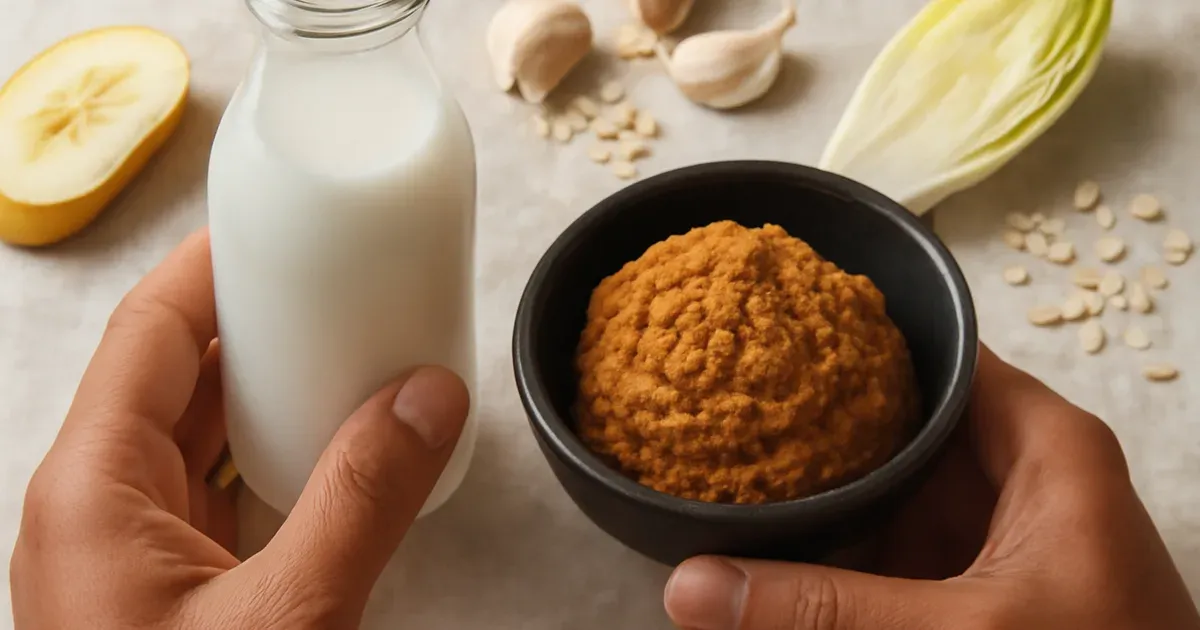
Three Pillars: Immunity, Digestion, and Mental Well-Being
Approximately 70% of the immune system resides in the gut, concentrated in structures called Peyer's patches and the gut-associated lymphoid tissue (GALT). The microbiome works in close partnership with these immune structures, helping to distinguish between harmful pathogens and harmless food antigens — a process that, when disrupted, can lead to chronic inflammation or autoimmune responses.
Dysbiosis — the state of microbial imbalance — is a term now routinely used in NHS gastroenterology literature. When harmful bacteria outcompete beneficial species, the gut barrier can become compromised (sometimes described loosely as "leaky gut"), allowing bacterial fragments to enter the bloodstream and trigger systemic inflammation. This underlies many of the associations between poor gut health and conditions such as rheumatoid arthritis, eczema, and mood disorders.
On the digestive side, a diverse microbiome is essential for breaking down dietary fibre, synthesising B vitamins and vitamin K, and extracting minerals from food. Research from the University of Reading and the Quadram Institute Bioscience in Norwich — one of the UK's leading gut health research centres — has detailed exactly how bacterial fermentation of fibre produces short-chain fatty acids (SCFAs) like butyrate, which nourish colon cells, reduce inflammation, and support gut barrier integrity.
Together, these three functions — immune regulation, mental health signalling, and digestive efficiency — make a compelling case for treating gut health UK-wide as a public health priority, not a lifestyle trend.
Prebiotics and Probiotics: What the Science Says
Probiotics are live microorganisms that, when consumed in adequate amounts, confer a health benefit on the host — the definition endorsed by the World Health Organisation and widely used by the British Nutrition Foundation. Found naturally in fermented foods such as live yogurt, kefir, sauerkraut, miso, and kimchi, as well as in supplement form, probiotics can reinforce the gut microbiome, particularly after disruption from antibiotics or illness.
The UK has one of the highest antibiotic prescription rates in Western Europe, making post-antibiotic microbiome recovery a particularly relevant concern for British adults. Several NHS trusts now include probiotic guidance in their post-antibiotic patient information materials, reflecting the growing clinical evidence base.
Prebiotics work differently but are equally important. They are non-digestible fibres — including fructooligosaccharides (FOS), galactooligosaccharides (GOS), and inulin — that selectively feed beneficial bacteria already present in your gut. The UK Eatwell Guide recommends consuming at least 30g of dietary fibre per day; the current national average is around 18g, meaning most British adults are substantially under-fuelling their gut microbiome.
When prebiotics and probiotics are consumed together, researchers use the term "synbiotics" to describe the synergistic effect. Prebiotic fibre nourishes introduced probiotic strains and resident beneficial bacteria alike, helping them produce SCFAs, crowd out pathogens, and maintain a resilient microbial ecosystem. MRC-funded trials at Imperial College London have examined synbiotic interventions in metabolic disease with promising early results.

How to Improve Gut Health Naturally: A Practical British Guide
Making meaningful changes to your gut health does not require an expensive supplement stack or a radical diet overhaul. The most effective interventions, as consistently recommended by the BDA and the British Nutrition Foundation, are rooted in everyday food choices and sustainable lifestyle habits.
Eat a wide variety of plants. The British Gut Project found that people who ate 30 or more different plant foods per week had significantly more diverse microbiomes than those eating fewer than 10. Diversity of plants drives diversity of microbes — aim for variety across vegetables, fruits, wholegrains, legumes, nuts, seeds, and herbs. Counting types rather than portions is a useful mental shift.
Prioritise fermented foods. Add live yogurt to your breakfast, try kefir in smoothies, or introduce miso soup as a starter. These are approachable, widely available in UK supermarkets, and evidence-backed for microbiome support. A 2021 Stanford University study, widely cited in UK nutrition media, found that a diet high in fermented foods increased microbiome diversity and reduced inflammatory markers more effectively than a high-fibre diet alone — suggesting both strategies are complementary.
Reduce ultra-processed foods (UPFs). UK adults now obtain approximately 57% of their daily energy from ultra-processed foods, according to research from Cambridge University. UPFs are typically low in fibre and high in emulsifiers and artificial additives, several of which have been shown in laboratory and human studies to disrupt gut barrier function and alter microbiome composition unfavourably.
Manage stress as a gut health intervention. The gut-brain connection runs both ways: chronic psychological stress suppresses beneficial bacteria and promotes pro-inflammatory species. NHS-recommended stress management tools — including mindfulness-based cognitive therapy (MBCT), regular physical activity, and adequate sleep — each have documented downstream benefits for microbiome health. The Wellcome Trust's ongoing mental health research programmes are beginning to include gut microbiome measurement as a secondary outcome, reflecting how seriously the scientific community now takes this link.
Move regularly. Multiple UK cohort studies have found associations between higher levels of physical activity and greater gut microbiome diversity, independent of diet. Even a 30-minute brisk walk most days — consistent with NHS activity guidelines — appears to have measurable microbiome benefits.

Reading Food Labels Through a Gut Health Lens
In the UK, front-of-pack traffic light labelling makes it relatively straightforward to identify high-fibre and low-additive options. When shopping with your microbiome in mind, there are a few practical rules of thumb endorsed by NHS dietitians and the BDA.
Look for products with at least 3g of fibre per 100g ("source of fibre") or 6g per 100g ("high in fibre") under UK food labelling regulations. Check ingredient lists for chicory root, inulin, or beta-glucan — naturally occurring prebiotics added to some fortified foods. For fermented products such as yogurt and kefir, look for "live cultures" or "active cultures" on the label, which indicates the probiotic bacteria have survived processing.
Be cautious of products marketed as "gut health" that are primarily UPFs. A product containing added inulin but also a long list of emulsifiers and sweeteners is unlikely to represent a net positive for your microbiome. The gut health UK market has grown substantially, and not all products live up to their labels — a reality the BDA has flagged in recent consumer guidance.
UK Microbiome Research: What Is Coming Next?
The UK is one of the world's leading centres for microbiome science, with BBSRC and Wellcome Trust-funded programmes at institutions including the Quadram Institute, the Sanger Institute, and King's College London generating data at a scale unprecedented in the history of nutrition research.
The ZOE PREDICT studies, led by Professor Tim Spector at King's College London, have produced some of the most cited personalised nutrition findings of the past decade, demonstrating that blood glucose and triglyceride responses to the same foods differ dramatically between individuals — largely driven by microbiome differences. This work is reshaping how NHS dietitians and researchers think about dietary guidelines, potentially moving from population-level recommendations toward personalised gut-health strategies.
UK Biobank linkage studies are now combining genomic, metabolomic, and gut microbiome data from tens of thousands of British participants, with early outputs connecting specific microbial signatures to IBS, inflammatory bowel disease (IBD), Parkinson's disease, and depression. The Medical Research Council has committed significant funding to this area through 2030, signalling long-term institutional confidence in the gut-brain connection as a tractable research frontier.
For the health-conscious UK adult reading this today, the practical takeaway is clear: the science is moving fast, it is largely confirming what early microbiome researchers hypothesised, and the interventions available to you right now — a plant-diverse diet, fermented foods, fibre, stress management, and physical activity — are the very same ones that researchers are validating at scale.
Bottom Line: Your Gut Health Action Plan
Improving gut health naturally is one of the highest-return investments you can make in your overall well-being. The evidence base — much of it generated right here in the UK — consistently points toward the same practical priorities: eat more diverse plants, include fermented foods, hit the NHS fibre targets, manage stress, and move your body.
The gut-brain connection means that caring for your microbiome is simultaneously an act of digestive care, immune support, and mental health maintenance. You do not need to overhaul your life overnight. Small, consistent shifts — an extra portion of legumes, a daily serving of live yogurt, a lunchtime walk — accumulate into meaningful microbiome change over weeks and months.
Your internal ecosystem is resilient, responsive, and remarkably willing to recover when given the right conditions. Start where you are, use what you have, and let the science guide you.
Frequently Asked Questions
What are the signs of poor gut health in the UK?
Common signs include frequent bloating, irregular bowel habits, persistent fatigue, and recurrent infections. Skin conditions such as eczema and acne have also been linked to microbiome imbalance in emerging UK microbiome research. If symptoms are persistent or severe, the NHS recommends speaking to your GP, who can rule out conditions such as IBS, IBD, or coeliac disease before attributing symptoms to general gut health.
How long does it take to improve gut health naturally?
Microbiome studies suggest measurable changes in gut bacteria can occur within two to four weeks of consistent dietary change. Research from the British Gut Project indicates that simply increasing plant diversity creates detectable shifts in microbiome composition within days. However, more profound and lasting changes — particularly reversing the effects of long-term poor diet or antibiotic use — may take several months of sustained effort.
Are probiotic supplements worth taking in the UK?
For most healthy adults, food-first sources of probiotics — live yogurt, kefir, kimchi, sauerkraut — are the approach most consistently endorsed by the British Dietetic Association. Supplements can be beneficial in specific circumstances, such as during or after a course of antibiotics, or for people managing IBS under clinical guidance. Strain specificity matters: not all probiotic products are equivalent, and the BDA advises looking for products with published clinical evidence for the specific strains included.
What is the gut-brain connection and why does it matter?
The gut-brain connection refers to the bidirectional communication network linking the enteric nervous system in the gut to the central nervous system in the brain, primarily via the vagus nerve. Because the gut produces the majority of the body's serotonin and influences systemic inflammation, the state of your microbiome has direct relevance to mood, anxiety, and cognitive function. UK researchers at UCL, King's College London, and the University of Oxford are actively investigating gut-targeted interventions for mental health conditions.
How much fibre do I need for good gut health in the UK?
The UK government recommends 30g of dietary fibre per day for adults, in line with guidance from the Scientific Advisory Committee on Nutrition (SACN). Most UK adults currently consume around 18g — a significant shortfall. Practical ways to close the gap include swapping refined grains for wholegrains, adding a portion of beans or lentils to at least one daily meal, eating the skin on fruits and vegetables where edible, and snacking on nuts and seeds rather than ultra-processed alternatives.
You might also like
- Gut Health UK: Eat Your Way to a Happier Gut
- How to Eat an Anti-Inflammatory Diet for Gut Health
- 7 High-Fibre Foods That Also Boost Your Gut Health
96 Bacterial Strains. Two Shots a Day.
GOODIE is an award-winning fermented drink with 96 live bacterial strains — more than any yogurt or kombucha — never pasteurised, clinically tested, and 8 in 10 users felt less bloating within 14 days. Curious?