How to Improve Your Oral & Gut Health in 6 Steps
A 6-step science-backed guide for UK adults to improve gut and oral microbiome health naturally, without radical diet overhauls.


You've tried cutting out sugar, swapping to "gut-friendly" yoghurts, and downloading yet another wellness app. Yet your digestion still feels sluggish, your energy is unpredictable, and nobody has told you that the bacteria living in your mouth might be as important as the ones in your gut. If you've been focused solely on your gut microbiome while ignoring the ecosystem sitting right above it, you may have been missing half the picture — and half the solution.
The good news is that improving gut health naturally doesn't require an expensive supplement stack or a radical diet overhaul. What it does require is understanding the connected system that runs from your mouth all the way to your colon — and taking a few consistent, science-backed steps to support it. This guide gives you exactly that: a practical, UK-grounded plan built on emerging microbiome science.
Why Poor Gut and Oral Health Happen in the First Place
The mouth is the gateway to the gut — literally. Everything you eat, drink, or breathe passes through your oral cavity before it ever reaches your digestive system. According to a peer-reviewed overview of the oral microbiome, the average adult carries between 50 and 100 billion bacteria in the mouth alone, representing around 200 predominant bacterial species from a pool of approximately 700 known oral taxa. When this community is disrupted, the downstream effects can ripple through the entire digestive tract.
In the UK, the picture is striking. NHS data consistently shows that tooth decay remains one of the most common reasons children are admitted to hospital, while gut conditions including irritable bowel syndrome (IBS) affect an estimated 10–20% of the UK population at any one time. Research from King's College London and the British Gut Project has reinforced what scientists are increasingly calling the "oral-gut axis" — the idea that bacteria from an imbalanced mouth microbiome can travel to the gut and alter its microbial landscape.
Key reasons the oral-gut system becomes dysregulated include:
- A low-fibre British diet that starves beneficial bacteria at both sites
- Frequent antibiotic use, which disrupts microbial diversity from mouth to colon
- Chronic stress activating the gut-brain connection and altering microbial balance via the vagus nerve
- Poor sleep, which UK Biobank research links to reduced microbial diversity
- Highly processed foods that feed harmful oral bacteria and reduce gut microbiome richness
Step 1: Audit Your Diet Through a Microbiome Lens
What you eat directly feeds — or starves — the bacteria that keep you healthy. The UK Eatwell Guide recommends at least five portions of fruit and vegetables daily, but microbiome research from the University of Reading and King's College London suggests that diversity matters as much as quantity. Researchers associated with the British Gut Project found that people who ate 30 or more different plant foods per week had significantly more diverse gut microbiomes than those who ate fewer than 10.
Start by counting how many different plant foods — fruits, vegetables, wholegrains, legumes, nuts, seeds, herbs, and spices — you eat in a typical week. Most UK adults land well below 20. Swap your usual loaf for a seeded wholegrain variety, add a tin of mixed beans to a midweek stew, and rotate your salad leaves rather than defaulting to iceberg every time.
For your oral microbiome, crunchy raw vegetables such as carrots, celery, and apples act as natural mechanical cleansers that support a healthy bacterial balance in the mouth. Reducing free sugars — already a key NHS recommendation — starves the harmful Streptococcus mutans bacteria most associated with dental caries.
Pro tip: Fermented foods such as live yoghurt, kefir, sauerkraut, and kimchi introduce beneficial bacteria at both sites. Look for products with "live cultures" on the label — widely available in UK supermarkets.
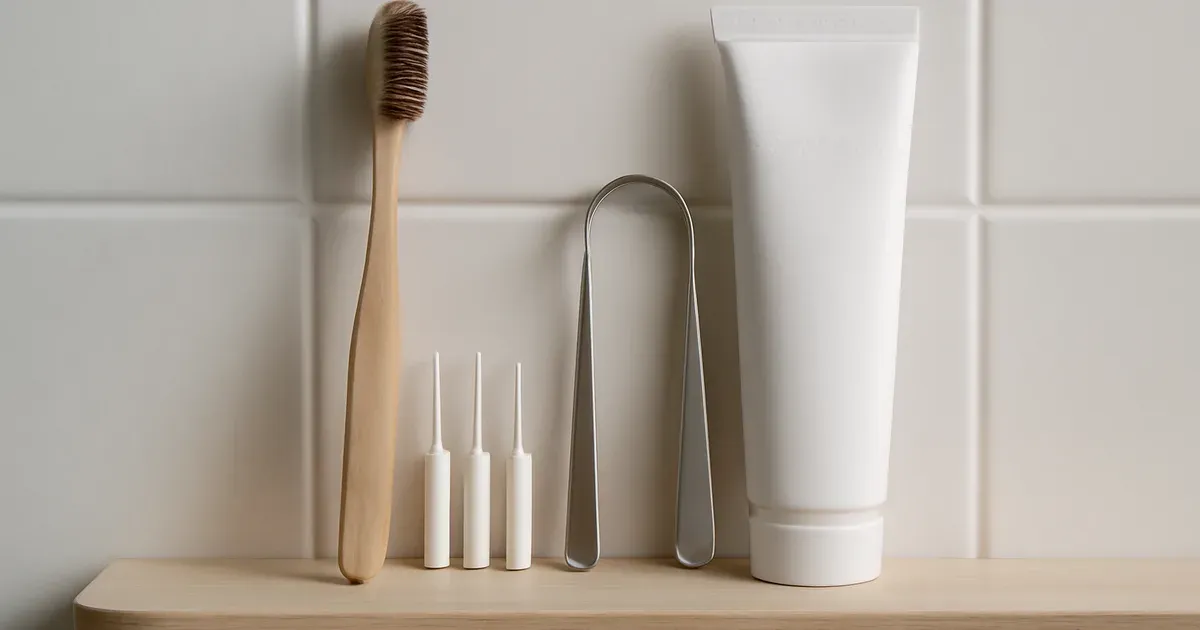
Step 2: Build a Consistent Oral Hygiene Routine (With Your Microbiome in Mind)
Most people brush their teeth to prevent cavities — but the real goal is microbial balance. The oral cavity is divided into multiple distinct habitats: the tongue, tooth surfaces, cheeks, tonsils, palate, and the subgingival crevice (the gap between teeth and gums). Each site hosts its own microbial community. Research shows that some species are highly site-specific — for example, Rothia colonises the tongue and tooth surfaces, while Simonsiella is found almost exclusively on the hard palate.
A routine that supports the oral microbiome goes beyond a two-minute brush. Floss or use interdental brushes daily to disrupt the bacterial biofilm (plaque) that accumulates in the subgingival crevice — the site associated with periodontal disease. Use a tongue scraper each morning, as the tongue harbours its own dense microbial community that contributes to the saliva mix swallowed into your gut throughout the day.
Avoid antibacterial mouthwashes containing chlorhexidine as a daily habit unless prescribed by your dentist. These products can reduce oral bacterial diversity indiscriminately, wiping out beneficial species alongside harmful ones. The NHS advises using fluoride toothpaste and visiting your dentist regularly — both of which remain the evidence-based foundation of oral health in the UK.
Pro tip: Chewing sugar-free gum after meals stimulates saliva, which is the mouth's natural antimicrobial defence system and helps buffer acid that would otherwise favour harmful bacteria.
Step 3: Actively Support the Gut-Brain Connection
Stress is not just a mental health problem — it is a microbiome problem. The gut-brain connection, mediated largely through the vagus nerve, bidirectional signalling molecules, and the enteric nervous system, means that chronic psychological stress measurably alters the composition of your gut microbiome. Research from UCL and Imperial College London has contributed to a growing body of evidence showing that stress hormones such as cortisol can reduce populations of beneficial Lactobacillus and Bifidobacterium species in the gut.
Building daily practices that downregulate your stress response is therefore a legitimate microbiome intervention, not just a wellbeing nicety. Even 10 minutes of diaphragmatic breathing or a short walk in green space has been shown in UK-based studies to reduce cortisol levels meaningfully. The NHS's Every Mind Matters platform offers free, evidence-based tools for managing stress that are accessible to everyone in the UK.
The gut-brain connection also works in the other direction: a healthier, more diverse gut microbiome produces more serotonin precursors (around 90% of the body's serotonin is made in the gut), which may improve mood and resilience to stress over time. Supporting one system supports the other.
Pro tip: Keep a simple food-and-mood diary for two weeks. Many UK adults are surprised to find that specific dietary choices — particularly high-sugar or ultra-processed meals — coincide with low mood or anxiety the following day, reflecting the gut-brain axis in real time.

Step 4: Prioritise Sleep as a Microbiome Recovery Tool
Sleep is when your gut repairs itself — and UK Biobank data involving hundreds of thousands of British adults has linked short sleep duration with lower gut microbial diversity. Adults in the UK average around 6.5 hours of sleep per night, below the NHS-recommended 7–9 hours for most adults. That shortfall has measurable consequences for the microbiome.
During deep sleep, the gut undergoes a "housekeeping" process called the migrating motor complex, which sweeps residual bacteria and food particles through the small intestine. Disrupted sleep interrupts this process, potentially allowing bacterial overgrowth in areas where it shouldn't occur. Prioritising sleep hygiene — consistent bed and wake times, a cool dark room, limiting screen light after 9pm — is genuinely one of the most powerful free interventions for gut health in the UK.
For your oral microbiome, sleep deprivation reduces saliva production, which raises the risk of a more acidic, caries-promoting oral environment overnight. Mouth breathing during poor sleep is also associated with altered oral bacterial communities, so addressing sleep-disordered breathing (which affects an estimated 1.5 million people in the UK with diagnosed sleep apnoea) can have surprisingly significant benefits for oral microbiome balance.
Step 5: Move Your Body to Shift Your Microbiome
Regular physical activity is one of the most consistently supported lifestyle interventions for microbiome UK research. Studies from the University of Cork (with UK-linked collaborators) and UK Biobank analyses have found that physically active individuals harbour greater gut microbial diversity and higher levels of short-chain fatty acid (SCFA)-producing bacteria, which are critical for gut lining integrity and reducing inflammation.
You do not need an intense training programme. The NHS recommends 150 minutes of moderate activity per week — brisk walking, cycling, swimming, or dancing all count. Even modest increases in daily step count have been associated with microbiome benefits in observational studies. The mechanism appears to involve both reduced systemic inflammation and improved gut motility, which alters the environment bacteria colonise.
From a gut-brain connection perspective, exercise also increases levels of brain-derived neurotrophic factor (BDNF), which supports the neural circuitry connecting the brain and the enteric nervous system. This creates a positive feedback loop: more movement, healthier gut, clearer mind, more motivation to move.
Pro tip: A 20-minute walk after your main meal is particularly effective. It supports gastric motility, blunts post-meal blood glucose spikes, and has been shown in a University of Leicester study to meaningfully reduce the risk of type 2 diabetes — a condition strongly linked to gut microbiome disruption in UK Biobank data.

Step 6: Get Tested and Track Your Progress
What gets measured gets improved — and in the UK, microbiome testing is now accessible to health-conscious consumers without a GP referral. The British Gut Project, run out of King's College London, is one of the world's largest citizen-science microbiome studies. Participating provides you with a snapshot of your gut microbial diversity compared to thousands of other UK participants, and contributes to real scientific research.
For oral health monitoring, the NHS recommends regular dental check-ups — typically every 6–24 months depending on individual risk. Your dentist can identify early signs of periodontal disease and discuss how your oral bacterial profile may be linked to broader health indicators. Emerging UK microbiome research, including work supported by the Wellcome Trust and the MRC, is beginning to examine oral bacteria as potential biomarkers for conditions including type 2 diabetes, cardiovascular disease, and certain cancers — though it is important to note these associations are not yet proven causal relationships.
Tracking your own markers at home — bowel regularity, stool consistency using the Bristol Stool Scale, energy levels, skin condition, and mood — gives you a practical feedback loop without requiring clinical tests. The British Dietetic Association (BDA) offers free dietary assessment resources on its website that UK adults can use to benchmark their fibre intake against the recommended 30g per day (most UK adults consume only around 18g).
Timeline: What to Expect Week by Week
Week 1–2: You begin increasing dietary diversity and tightening oral hygiene habits. Energy may fluctuate as your gut adjusts to more fibre. Bloating is common and temporary — it signals that your gut bacteria are responding.
Week 3–4: Sleep improvements and stress-reduction practices begin to show measurable benefits. Many people report more regular digestion, improved stool consistency, and reduced afternoon energy crashes by the end of week four.
Week 6–8: With consistent physical activity added, microbial diversity begins to shift in measurable ways. Research suggests six to eight weeks is the minimum window for lifestyle-driven microbiome changes to become stable. You may notice clearer skin, reduced bloating, and improved mood — all consistent with a healthier gut-brain connection.
Three months and beyond: Sustained dietary diversity, regular exercise, good sleep, and low-stress practices produce lasting microbiome changes. Studies from King's College London suggest that these changes can persist for months after the intervention continues — making consistency the single most important variable.
Mistakes That Slow Your Progress
- Relying on a single probiotic supplement rather than building dietary diversity. Most UK probiotic products contain only one or two strains, whereas a healthy microbiome contains hundreds of distinct species.
- Using antibacterial mouthwash daily without clinical guidance, reducing oral microbial diversity and potentially disrupting the bacteria that produce nitric oxide — a molecule important for cardiovascular and gut health.
- Ignoring stress as a microbiome factor. Many UK adults address diet and exercise but overlook the chronic psychological load that actively reshapes their gut-brain connection.
- Expecting rapid results. Microbiome changes require weeks of consistent behaviour, not days. Impatience leads to abandonment of habits before benefits emerge.
- Consuming ultra-processed foods (UPFs) — which make up nearly 57% of the average British adult's diet according to research published by the University of São Paulo and replicated in UK population studies — actively undermines microbiome diversity regardless of other positive habits.
What Can Help You Get There Faster
Dietary tools: A high-quality prebiotic supplement (such as inulin or fructooligosaccharides) can accelerate the feeding of beneficial gut bacteria while you build dietary diversity. Look for products certified by the British Nutrition Foundation or with peer-reviewed evidence behind the specific strain or fibre included.
Tracking and testing: The British Gut Project microbiome kit gives you a personalised gut health baseline and contributes to UK microbiome research. Pair it with the NHS-recommended Eatwell Guide to benchmark your dietary intake.
Professional support: A HCPC-registered dietitian — searchable via the BDA's "Find a Dietitian" tool — can provide a personalised gut health plan tailored to your NHS medical history, food preferences, and lifestyle. This is especially important if you have a diagnosed gut condition such as IBS, IBD, or coeliac disease.
Your 6-Step Summary
✅ Step 1: Increase dietary plant diversity to 30+ foods per week; reduce free sugars for both oral and gut microbiome health ✅ Step 2: Build a site-specific oral hygiene routine — brush, floss, scrape; avoid daily antibacterial mouthwash ✅ Step 3: Practise daily stress reduction to support the gut-brain connection and protect microbial diversity ✅ Step 4: Prioritise 7–9 hours of quality sleep to allow gut repair and maintain healthy saliva production ✅ Step 5: Aim for 150 minutes of moderate movement per week to boost microbial diversity and gut motility ✅ Step 6: Track your progress with the British Gut Project, regular dental check-ups, and home symptom monitoring
Ready to Take the First Step?
Your mouth and your gut are speaking to each other constantly — and with the right habits, you can make sure that conversation is a healthy one. The science of microbiome UK research is moving fast, and you don't need to wait for a clinical prescription to start benefiting. Pick one step from this guide today. Just one. Build from there.
You might also like
- The Oral Microbiome: Your Biggest Questions Answered
- Bioma Probiotic Claims Reviewed: 2026 Gut Health Findings
- Medications May Permanently Alter Gut Microbiome
Frequently Asked Questions
How long does it take to improve gut health naturally?
Most research suggests that meaningful, measurable changes in gut microbial composition can occur within six to eight weeks of consistent dietary and lifestyle changes. Short-term shifts in bacterial populations can be detected within days of dietary change, but stability — meaning lasting improvement — typically requires at least two to three months of sustained new habits.
Is the oral microbiome really connected to gut health?
Yes. Bacteria from the mouth are swallowed continuously throughout the day, entering the gastrointestinal tract with every meal and sip of water. Studies supported by UK institutions including King's College London have found that an imbalanced oral microbiome can seed the gut with bacterial species that alter gut microbial composition and promote inflammation. This oral-gut axis is an active area of NHS gut health research.
What does the NHS recommend for gut health in the UK?
The NHS recommends a high-fibre diet (30g per day), regular physical activity, adequate hydration, and minimising ultra-processed foods. The NHS Eatwell Guide provides the dietary framework most aligned with supporting a healthy gut microbiome for UK adults. For persistent gut symptoms, the NHS advises consulting a GP who may refer to a gastroenterologist or registered dietitian.
Can stress really damage my microbiome?
Yes. Chronic stress activates the hypothalamic-pituitary-adrenal (HPA) axis, releasing cortisol and adrenaline that alter gut motility, gut barrier permeability (sometimes called "leaky gut"), and the composition of the microbiome. Research from UCL and Imperial College London has contributed to evidence showing that stress-related shifts in gut bacteria can in turn affect mood and anxiety via the gut-brain connection — creating a cycle that requires both psychological and dietary intervention to break.
Should I take a probiotic supplement to improve gut health in the UK?
Probiotics can be beneficial for specific conditions — the BDA and British Nutrition Foundation both acknowledge evidence for particular strains in managing IBS symptoms and antibiotic-associated diarrhoea. However, a single-strain supplement is not a substitute for dietary diversity. The most robust evidence for improving gut health naturally in the UK points to a varied, plant-rich diet as the primary driver of a healthy microbiome — with targeted probiotic use as a complement, not a replacement.
96 Bacterial Strains. Two Shots a Day.
GOODIE is an award-winning fermented drink with 96 live bacterial strains — more than any yogurt or kombucha — never pasteurised, clinically tested, and 8 in 10 users felt less bloating within 14 days. Curious?